Automation & Operations
Should you automate Airbnb guest messages? What I'd schedule and what I'd write myself
Some guest messages are the same for every stay and can go out on their own. Others need a person. Here's where I'd draw that line, and when I'd start looking at a tool.

On this page
- Airbnb's built-in messaging: check-in details, quick replies, auto-replies
- The messages I'd schedule
- The messages I'd always write myself
- Review requests and links: what an automated message can't say
- Where automated messages go wrong
- AI replies: drafts I'd approve vs. a bot on autopilot
- How much to automate: a threshold by channel, listings and who answers
- Vrbo and Booking.com: their own schedulers and rules
- A quick audit I'd run before the next booking

Parking, the Wi-Fi password, the door code: the same few questions tend to arrive with every booking. The message that decides how a stay ends is rarely one of them. It's the guest who can't get in, or the one who wants money back.
My rule would be simple. I'd schedule the messages that are identical for every guest and purely factual, and I'd write anything emotional, urgent or about money myself.
Airbnb already shares your check-in instructions on its own, and in May 2026 it announced AI auto-replies that answer some guest questions as Airbnb. It said they were "rolling out in the coming months," and we couldn't confirm they've reached US hosts. RentalWe's editors, the "we" in this article, read every cited page on October 17, 2026.
Key Takeaways
- I'd schedule only identical, purely factual messages: a welcome, an arrival reminder, checkout steps, a thank-you.
- A lockout, a refund request or a date change gets a reply I'd write myself. Vrbo doesn't even count automatic replies as an adequate answer to critical stay questions, like a door code.
- Every guest can get the same review request. Airbnb bars trading anything of value for a review, and the FTC's guides say asking only happy guests may be deceptive if it makes posted reviews substantially more positive.
- A second platform, not a booking count, is where I'd start looking at a channel manager or property management software (PMS). No tool replaces a person who answers within the hour.
Airbnb's built-in messaging: check-in details, quick replies, auto-replies
First, I'd check what Airbnb already sends, so guests don't get it twice.
Check-in instructions. You write them once in the arrival guide, and guests see them "48 hours before check-in," per Airbnb's check-in instructions page; a 2026 Resource Center page says "24 to 48 hours." For self check-in, Airbnb's guest check-in guide says the door or lockbox code "will be emailed and sent as a message 48 hours before your arrival."
Scheduled quick replies. That's the current name for scheduled messages. You give a saved template a trigger (booking confirmed, check-in or checkout) and an offset, and it goes out "in the listing's time zone," per Airbnb's scheduled quick replies page. Details (placeholders) fill in the Wi-Fi password, checkout instructions and more (an entry code too, with a connected smart lock in the US or Canada), but "they won't work if you manually type them," warns Airbnb's first-guest guide, so insert them from the drop-down menu.
Suggested quick replies. AI picks one of your saved replies; Airbnb's quick replies guide says "The suggestion appears in your conversation, where only you can see it." Nothing goes out unless you send it.
Auto-replies. Airbnb's May 20, 2026 announcement says "Guests receive AI-powered answers to common questions with details pulled from your listing page," and "Each auto-reply identifies Airbnb as the sender, and both you and your guests can see it. You can delete the reply and send a different response anytime."
We couldn't confirm whether auto-replies can be switched off or count toward response rate, and no Help Center article covers them. The answers draw on your listing, so by our reading an outdated listing would produce outdated answers.
- Arrival guide (check-in instructions). Who writes it: You, once. Sent without you?: Yes, 24 to 48 hours before.
- Scheduled quick reply. Who writes it: You. Sent without you?: Yes, on its trigger.
- Suggested quick reply. Who writes it: Your saved reply, picked by AI. Sent without you?: No.
- Auto-reply (announced). Who writes it: Airbnb's AI, from your listing. Sent without you?: Appears so; Airbnb hasn't documented it.
- Connected third-party tool. Who writes it: You or the tool's AI. Sent without you?: Depends on its settings.
The messages I'd schedule
If I were setting this up, I'd schedule four or five messages, each the same for every guest, timed to Airbnb's own key-moment advice.
Vrbo and Booking.com both claim a payoff from good arrival information and fast answers, though neither publishes the data behind it. Vrbo says guests with easy access to arrival information "are more likely to have smooth check-in experiences and leave better property reviews" (Vrbo's welcome guide page), and Booking.com says "when guests get quick answers, they're less likely to cancel" (Booking.com's Messaging Tools page).
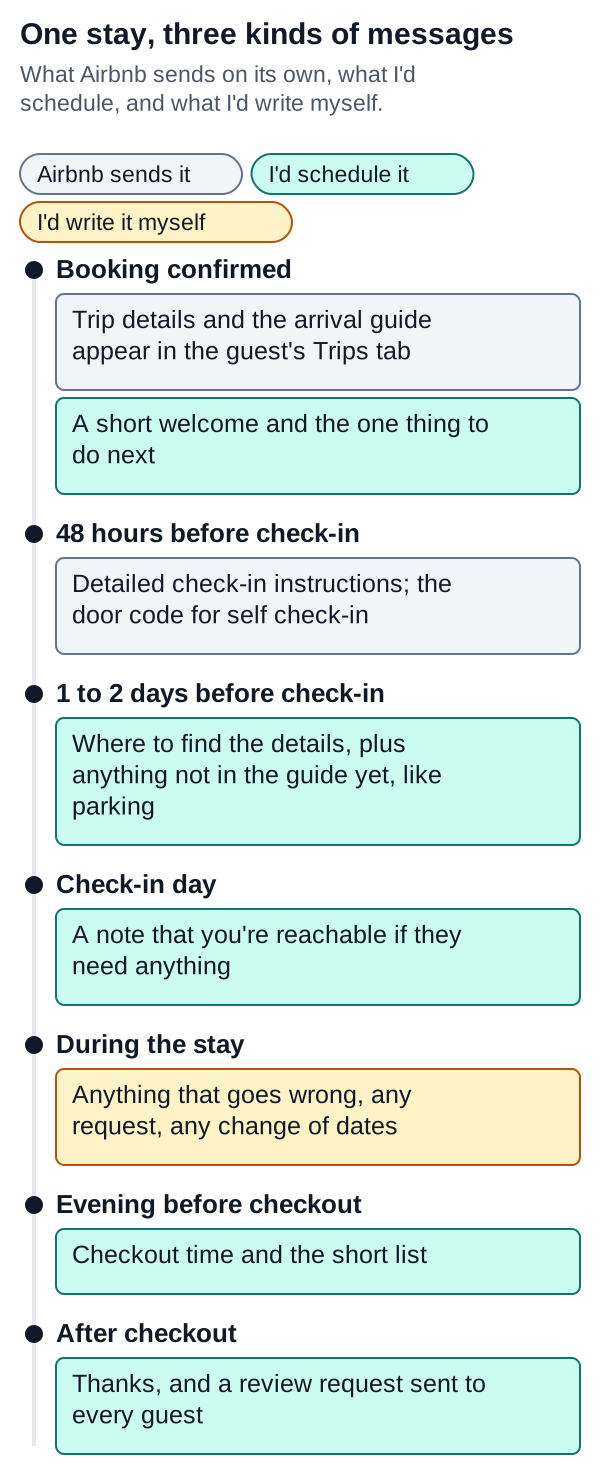
- Booking confirmed. A short welcome and the one thing to do next.
- A day or two before check-in. Airbnb's guide to communicating effectively suggests reminding guests "that they can find details and directions in their Trips tab." I'd point there instead of repeating the code, and add anything the arrival guide doesn't cover yet, such as parking if it isn't in there.
- Check-in day. Airbnb's check-in and checkout guide says to "let guests know you're available if they need anything."
- The evening before checkout. Checkout time and a short list, per the quick replies guide.
- After checkout. Thanks and a review request for every guest. The same guide times the thank-you and a feedback request "24 to 48 hours after they've checked out."
A day-before template could read like this (an example, not a script to copy):
Hi [guest's first name], your check-in details are in the Trips tab of the Airbnb app. Parking is [where to park]. If anything doesn't work when you arrive, reply here.
Airbnb also suggests a message after the first night; I'd skip it or write it by hand. My rule would be fewer, shorter messages: in one study of international guests staying in Airbnbs across India, about a third were uncomfortable when contact felt "too frequent or too personal," per the authors' summary in The Conversation. The authors recommend short, polite messages that tell guests help is available.
Settings I'd check first, from Airbnb's scheduled quick replies page unless noted:
- Where they live: Messages, then Settings, then Manage quick replies, then Create. "Scheduled for" sets the time, like "1 day before check-in at 10:00 AM" (quick replies guide).
- New templates apply "to current and upcoming reservations," including guests who booked weeks ago.
- "For last-minute bookings or short stays, some messages will be skipped by default" unless you turn on the "Send for last minute bookings and short stays" toggle.
- Deleting a template removes its unsent scheduled messages.
- A detail with an empty listing field will "display as unavailable."
- Messages max out at 4,000 characters, per Airbnb's quick replies page, and its temporary phone numbers page says templates using the retired guest phone number shortcut "will no longer be sent."
Our suggestion: read each template as a guest arriving late tonight. The timeline view lets you skip, edit or send one early for a single reservation.
The messages I'd always write myself
I'd write anything where the guest is upset, stuck, or asking for money or a change:
- A guest who can't get in
- A complaint or refund request (what I'd do when a guest asks for a refund)
- A noise or neighbor problem (the first hour of a noise complaint)
- Anything about health or safety, like a guest claiming bed bugs
- Date changes, early check-in or late checkout
- The first reply to a booking inquiry, the reply Airbnb's response rate measures
Vrbo's rule is the bluntest: "Automatic replies do not count as an adequate response," says Expedia Group's Host Communication Policy, which covers Vrbo rentals. It applies to any question about critical stay information, such as a door code. On check-in day and during the stay, if one arrives between 8 a.m. and 9 p.m. property time, the reply is due within 1 hour.
Airbnb's host ground rules set a similar bar: "Close to check-in time, or if a time-sensitive issue arises during the stay," hosts are expected "to respond within 1 hour to guest messages received during local daytime hours."
Airbnb's Content Policy covers "content generated or edited using AI," including "messages to Airbnb, hosts, or guests," and says "Users are responsible for their content." By our reading, a wrong answer about an amenity from a tool that replies as you is also a host statement, which the ground rules say "should accurately describe the home."
Review requests and links: what an automated message can't say
Asking every guest for a review is fine. Tying anything to a good review isn't, and neither is steering guests off the platform.
Airbnb itself suggests a note after checkout "thanking guests and asking them to leave a review," and one of its sample templates says "I hope you had a five-star stay." Airbnb's Reviews Policy bars reviews given or withheld "in exchange for something of value," which is why I'd never trade a refund for a review.
The FTC's binding review rule, 16 CFR 465.4, bans incentives "conditioned expressly or by implication" on a particular sentiment. Its interpretive Endorsement Guides, 16 CFR 255.2, say inviting only customers with very positive feedback "may be an unfair or deceptive practice" if it makes posted reviews "substantially more positive" than they'd otherwise be. Inviting all recent purchasers "would not have been unfair or deceptive," even with a stated hope for positive reviews. So I wouldn't send the ask only to guests who replied happily. This isn't legal advice.
Links are the other trap. Airbnb's Pricing and payment transparency policy bars "links in listing pages or messages that take people off of the Airbnb platform," listed under its rules on keeping payments on Airbnb, next to a ban on communicating off-platform before booking. Airbnb may also "suggest or require text to be removed" when its systems detect "external links" (Airbnb's message review page), yet allows document links on Google Drive, Dropbox, OneDrive or WeTransfer (Airbnb's document sharing page). It doesn't say where a link to a third-party digital guidebook falls (Airbnb's own guidebook is a built-in detail), so I'd keep the essentials in the message.
Expedia Group's Off-Platform Booking Policy bars Vrbo links "intended to redirect guests away from Vrbo," and Booking.com's messaging security guide says that once a partner turns on its approved-links setting, it will "remove any unregistered links."
Where automated messages go wrong
The failures we found fall into three kinds: wrong timing, messages that contradict the host, and a bot answering what it shouldn't.
In a July 2026 Airbnb Community Center thread, a Michigan cabin host said the timing "isn't consistent or accurate": "it sent a welcome message" before the guests had arrived, "as if they were already at the cabin." The host later said they had no scheduled quick replies and the problem was "the message showing up in the message thread." A Community Champion, a volunteer host rather than Airbnb staff, replied that suggested replies aren't sent unless the host sends them. The thread never settled what reached the guest; in that host's place, I'd check the reservation's timeline first.
Airbnb's setup adds quieter failures: co-hosts can't view or edit the host's templates (though they can skip upcoming messages), so we infer two people could schedule overlapping messages.
A May 2026 user request on Hospitable's feedback board, not a company statement, says "AI Auto Reply sometimes sends a follow-up message that contradicts the host's manual response." We'd expect any tool that sends on its own to carry that risk.
In April 2026, 404 Media reported that guests "seemingly realized" a host was using an AI chatbot and "tricked the chatbot into instead providing a fairly detailed recipe for French toast." Airbnb told 404 Media it allows certain hosts to use tools that reply for them outside their typical hours. According to TechSpot, Airbnb says those tools should assist rather than replace direct host communication, and it expects hosts to stay reachable and messages to stay accurate and consistent with its policies.
Suspicion itself can cost you, though none of these studies tested host messages. In online chat experiments, Hohenstein et al. (2023) found "people are evaluated more negatively if they are suspected to be using algorithmic responses," even though smart replies sped up conversation and increased positive language. Jakesch et al. (2019) found readers distrusted Airbnb hosts suspected of AI-written profiles only when AI and human profiles were mixed. Our inference: a robotic auto-reply inside a personal thread is that mixed case.
In marketing experiments, Kirk and Givi (2025) found that believing an emotional message was AI-written lowered word of mouth and loyalty, an effect that "is attenuated for factual (vs. emotional) messages." Not every study agrees: in surveys built on hypothetical emails, Liu et al. (2022) found trust fell when readers were told AI was involved, but rose when AI helped write more interpersonal emails rather than transactional ones, the opposite direction from Kirk and Givi.
AI replies: drafts I'd approve vs. a bot on autopilot
I'd let AI draft. I wouldn't let it send anything that isn't a fixed fact.
Who's speaking matters: Airbnb's announced auto-replies sign as Airbnb, while a third-party bot replies as you. Airbnb lets hosts connect "a messaging software" (Airbnb's software switching page), but its Terms of Service bar using "bots, crawlers, scrapers, or other automated means" to "interact with the Airbnb Platform." By our reading, software Airbnb lets you connect is the exception, so an approved partner tool is the authorized route, which fits TechSpot's line that such tools are "available only through approved software partners."
What I'd check in any tool:
- Does it draft or send? For anything beyond fixed facts, I'd stop at drafts I'd approve before sending, like Airbnb's suggested quick replies or Booking.com's "Help me reply" (Booking.com's guide to contacting guests).
- Which topics does it refuse? Hospitable's AI Auto Replies page, for a feature on one paid plan, lists topics it won't answer, including refunds and compensation, payments, date changes, and sharing lock codes or Wi-Fi before a booking is confirmed. It adds that "some of these restrictions may be lifted," and a host's own notes on early check-in and late checkout override the block on those.
- Does it hand urgent messages to a person? For something like a lockout, Hospitable's Auto Reply sends the guest the host's own pre-written escalation message instead of an AI answer. Its help page mentions alerts only when Auto Reply can't send, not when it escalates, so I'd find out how I'd know. On Vrbo, we infer, that message would itself be an automatic reply.
- Where does guest data go? Airbnb's AI features page lets you turn off the "Help improve AI-powered features" setting, which covers Airbnb's use of your own personal information to improve its AI models. For a third-party tool, I'd read its terms.
How much to automate: a threshold by channel, listings and who answers
The threshold isn't a booking count; we found no study that offers one. My answer would be the same four or five scheduled messages at any size, a channel manager or PMS once a second platform splits the inbox, and a person, not a tool, for the 1-hour daytime window. At 60 units, the number I manage, I'd still size it by those three things: channels, listings and who answers.
- One listing, Airbnb only. Scheduling is built in, so I'd schedule the four or five identical messages from the first booking, add a quick reply for any question that keeps coming up, use suggested replies (I'd approve each one), and write the rest.
- Several listings, or co-hosts. The same, plus agreeing who owns the templates, since co-hosts keep separate ones (team members share one set). Airbnb's maintaining quality guide describes a Superhost with 36 listings who schedules one short arrival message three days before check-in. By our reading, the message count needn't grow with the listings.
- More than one platform. Each scheduler works only in its own inbox, as far as we can tell. That's where I'd start looking at a channel manager or PMS with messaging triggers (see channel manager vs. iCal sync). If you'd text Booking.com guests through a PMS, note that Booking.com stopped sending their phone numbers to channel managers (Booking.com's guest phone number change).
- Whatever the size. I'd let AI auto-send only fixed facts, with money, dates, access and safety blocked. If I couldn't cover the 1-hour daytime window myself, I'd bring in a co-host or a team member for it. At most, a tool can route the urgent message to them.
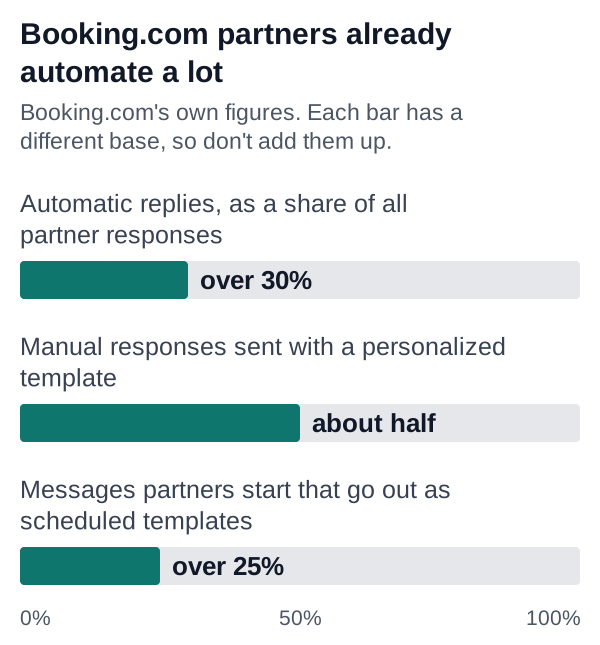
By Booking.com's own figures, automation is already routine among its partners (Messaging Tools page), yet its guide for new partners, while recommending templates, says "guests value personal connection."
By our reading, scheduling won't lift your Airbnb response rate, though no Airbnb page says so. Airbnb's response rate page counts "new inquiries and reservation requests you responded to within 24 hours in the past 30 days," and scheduled quick replies fire only after a booking exists. Speed is also associated with bookings: across 22 cities, Sengupta et al. (2021) found host response time among the most significant predictors of Airbnb bookings, in cross-sectional data that used reviews as a stand-in for bookings.
Vrbo and Booking.com: their own schedulers and rules
Vrbo's template help page now lets you schedule for "Specific times, such as 10 AM the day before check-in" or "Booking events," a fall 2026 launch Expedia Group's partner blog lists as "Available in the US only." Vrbo already emails your welcome guide "three days before check-in" (Vrbo's welcome guide page) and sends eligible guests a review link at checkout (Vrbo's review help page).
Response metrics aren't among Vrbo's Premier Host criteria, and an archived April 2026 copy of its responsiveness page said they "don't affect your listing's ranking or visibility." Expedia's 1-hour rule still applies. We found no Vrbo AI reply feature.
Booking.com's templates and automatic replies guide lists six schedule points, from "When a guest makes a booking" to "One day before departure," plus automatic replies by topic. Its "Help me reply" drafts can be switched off.
A quick audit I'd run before the next booking
If I were starting this week, I'd list everything that can message a guest without me: scheduled and suggested replies, auto-replies if they've arrived, connected tools, Vrbo or Booking.com templates. Then I'd read each as a tired guest would at 11 p.m. and fix the stalest first, including the listing text auto-replies draw on.
Update, October 26, 2026: Airbnb renamed its off-platform policy Pricing and payment transparency, so the links paragraph now quotes the new page.
Common questions
Do scheduled messages count toward my Airbnb response rate?
We found no Airbnb page that says so. Scheduled quick replies fire only after a booking exists, so by our reading they don't answer the new inquiries and requests the metric counts. Airbnb's Instant Book page says Instant Book "positively affects your response rate," which we take to mean there are fewer requests to answer. Superhost status separately requires responding to "90% of new messages" within 24 hours; no page says whether a scheduled message counts toward it. Whether auto-replies count for the host is undocumented.
Can I turn off Airbnb's AI auto-replies?
We found no Help Center article or documented setting for that as of October 17, 2026. Suggested quick replies are different: only you see them, and you can ignore them. In a July 2026 Community Center thread, Community Champions, who are volunteer hosts, described a setting to turn suggested replies off, and the host there said suggestions kept showing after it was off.
Should I put the door code in a scheduled message?
For self check-in, Airbnb already sends the code 48 hours before arrival, though its own self check-in guide also suggests a message "a day or two before check-in to share the code." I'd point guests to the Trips tab instead, so there's one place to update and no stale code in an old template. With a connected smart lock in the US or Canada, the "Entry code" detail can fill it in.
Is it OK to use ChatGPT to write guest messages?
We found no Airbnb rule against it. Its Content Policy covers AI-generated content, messages included, and says "Users are responsible for their content." I'd keep guest names, phone numbers and reservation details out of a general chatbot, and I'd never let it promise a refund or an amenity the listing doesn't have. A draft I'd reread and edit before sending is the only use I'd be comfortable with.
Can an automated message ask for a five-star review?
Yes, if it's phrased as a hope and every guest gets the same ask. Airbnb's own sample template says "I hope you had a five-star stay." What crosses the line is tying anything of value to the review, which Airbnb's Reviews Policy prohibits; the FTC's review rule bans incentives conditioned on a review expressing a particular sentiment. Sending the ask only to guests who replied happily is the practice the FTC's Endorsement Guides say may be unfair or deceptive if it makes posted reviews substantially more positive. This isn't legal advice.
Sources
Show sources (52)Hide sources
Read next
Automation & Operations
Why Airbnb hosts are pushing back on the new checkout rules, and what it costs you
Cina ·
Guest Experience
Screening Airbnb guests: which red flags matter, and whether to keep Instant Book on
Cina ·
Pricing & Revenue
Guest cancels or leaves early on Airbnb? What you keep, and when I'd refund anyway
Cina ·


