Automation & Operations
Why Airbnb hosts are pushing back on the new checkout rules, and what it costs you
Hosts are pushing back on Airbnb's new checkout rules, but the rules still apply to stays booked from November 20, so here's what they add to your turnover and how I'd pay for it.

On this page
- The checkout rules backlash: what hosts object to and what Airbnb says
- Which checkout chores move from your guest to your turnover
- How much time does it add to a same-day turnover?
- Fix laundry first: spare sets take it off the clock
- Should you raise your cleaning fee?
- Buy time instead of labor: widen the turnover window
- What I'd agree on with a cleaner before the first checkout under the new rules
- Rewrite your Airbnb house rules and requests before November 20
- What I'd do before November 20

Picture a cleaner walking in at noon: beds still made, sink full, trash in the kitchen. Check-in is at 4.
For Airbnb stays booked on or after November 20, 2026, that's the new normal under Airbnb's checkout rules, and hosts are pushing back. "Keep Self-Catering Self-Catering," a Change.org petition started in the UK on October 21, had more than 7,000 verified signatures when we checked on October 23.
Airbnb's house rules policy says hosts are "generally not allowed" to ask guests to do tasks "that require significant effort or time, or would typically be performed by a cleaner." Its examples are stripping the bed, washing and putting away dishes and taking trash off-site; Airbnb's announcement adds starting a load of laundry.
Earlier bookings keep the rules and requests the listing had when they were booked (Airbnb's house rules help), but even on those, Airbnb's ground rules for guests bar fees for skipped checkout tasks.
For the policy itself, see our Update on Airbnb's house rules policy. RentalWe's editors, the "we" in this article, read every Airbnb page cited here on October 23, 2026; this is our reading of them, and it isn't legal or tax advice.
Key Takeaways
- Hosts are pushing back on the new checkout rules, and a petition started in the UK had more than 7,000 verified signatures when we checked on October 23. Airbnb's policy page still applies the rules to reservations booked on or after November 20, so I'd plan for that.
- On bookings from November 20, 2026, guests can generally still be asked to put dishes in the sink, gather towels and sort trash into indoor bins. Stripping beds, laundry, washing dishes and taking trash off-site generally fall to the turnover.
- Machines set the pace: Whirlpool says a Normal dishwasher cycle usually runs about 2 to 3 hours, and laundry loads queue through the machines, whoever is cleaning.
- Airbnb's 15.5% host fee, paid by most hosts, applies to the cleaning fee, so keeping an illustrative $30 more per turnover takes a raise of about $35.50.
- Airbnb says the cleaning fee covers standard cleaning, and its search weighs total price.
- Before raising a fee, I'd buy an extra linen set per bed and time one turnover with the chores undone.
The checkout rules backlash: what hosts object to and what Airbnb says
The Change.org petition sums up the objection in one line: "Guests should not be expected to clean somebody else's home, but they should be expected to clean up after themselves." It also supports Airbnb's efforts "to prevent unreasonable demands such as stripping beds, laundering linen, deep-cleaning kitchens or undertaking professional cleaning tasks."
Its asks start where Airbnb's own examples stop. Airbnb's announcement still lets you ask guests to put used dishes in the sink and sort trash into designated indoor bins. The petition wants hosts to be able to require guests to wash up and use designated bins at the property, and it wants Airbnb to consult hosts before changes like this.
TechCrunch reported the change as "sparking backlash from hosts" and quoted a host on Airbnb's community forums: "Guests are given complete freedom to be lazy while the hosts bear the risk." The outlet tied the change to "years of backlash regarding overly burdensome checkout instructions and hefty fines for not disposing of trash," and noted that many guests have asked on social media why they should clean after already paying a cleaning fee. The same question runs through one Reddit thread, covered in the fee section below.
The objections in the host threads we read are practical. One host's only requests were loading and starting the dishwasher and putting trash in the outdoor bins (r/airbnb_hosts). The reasons were same-day turns and days the cleaner can't come until the next day. Another points to trash piling up on a long stay (r/airbnb_hosts), and a host in an Australian Facebook group says the extra work can mean cleaners expect more money.
An Airbnb spokesperson told Telegraph Travel: "House rules help guests understand what hosts expect, but we've heard from our community that they can be confusing, onerous and hard to manage" (The Telegraph via Yahoo).
Not every host objects. The same piece quotes one who has hosted for eight years in Richmond and Cornwall: "I've never asked guests to do chores."
When we checked on October 23, we found no Airbnb statement about changing the policy. Its house rules policy still opens with "This policy applies to all reservations booked on or after November 20, 2026." Whatever happens to the petition, I'd plan for that date.
Which checkout chores move from your guest to your turnover
The four examples in Airbnb's October 20 announcement are the clearest map of what's left.
- Dishes. You can still ask: Put used dishes in the sink. Now falls to your turnover: Washing and putting away (dishwasher loading: see below).
- Laundry. You can still ask: Gather used towels. Now falls to your turnover: Stripping beds, starting a load.
- Trash. You can still ask: Sort trash and recycling into designated indoor bins. Now falls to your turnover: Taking garbage off-site.
- Air conditioning. You can still ask: Turn it off when leaving. Now falls to your turnover: Nothing new.
- Lock up. You can still ask: A standard rule, with optional key-return details. Now falls to your turnover: Nothing new.
Guests "must follow" house rules and "are encouraged to comply with hosts' requests" (Airbnb's policy), and the announcement ties its cancel-without-fees option to a broken house rule. So anything your turnover depends on has to be a standard rule, like lock up, or turnover work.
Dishwashers are the gray area: no current Airbnb page we read mentions them. One host in a Facebook group post reports the editor flagged a request to load and start the dishwasher, and that support called it policy. I wouldn't build a turnover around guests loading it.
Airbnb's check-in and checkout guide says of tasks like gathering used towels: "Making these chores part of your own cleaning routine could lead to better reviews." It asks hosts to consider whether even that creates a 5-star experience.
Exceptions depend on context. Airbnb's policy gives two examples: shorter showers "due to local drought-related water restrictions," and trash "in an animal-proof container in bear country."
Enforcement starts in the editor, which highlights noncompliant requests; Airbnb then emails you with a chance to appeal. Unresolved issues can bring a guest alert such as "includes cleaning requests" (announcement), and persistent violations can mean "reduced listing visibility in search" (policy).
Guests who rate a listing's accuracy "must give at least one reason," which "can include unexpected or excessive rules or requests." Listings with repeated low ratings from unreasonable requests "may be removed from Airbnb" (Airbnb's checkout guide).
How much time does it add to a same-day turnover?
We found no source that measures hands-on minutes for these tasks. Machine time is measurable, and it sets the pace however many cleaners you send.
With no times set, Airbnb's early check-in help uses "3:00 PM check-in and 11:00 AM checkout," a 4-hour window; hosts set their own (check-in and checkout help). Our example uses 4:00 PM, which leaves 5 hours.
For scale, operations software vendor Breezeway puts average cleaning jobs at 2.99 hours for one bedroom, 3.59 for three and 4.92 for six. Those are elapsed job times, often with several cleaners. Breezeway says its platform has run tasks in 90 countries but doesn't state the region, method or period behind these averages.
Dishes
Whirlpool says "Normal cycles usually run between roughly 2 and 3 hours," within an overall range of 1.5 to 4 hours. Consumer Reports' lab (updated March 10, 2019) measured "90 to 200 minutes" on normal cycles.
Long cycles are by design: "Efficient dishwashers run longer to save water and energy," and the 1-hour wash "will reduce drying performance" (Whirlpool).
If the cleaner starts it first thing, a Normal cycle of 2 to 3 hours, which Whirlpool says includes drying, can finish inside a 4-hour window with 1 to 2 hours left to unload. Without a dishwasher, every dish is hand labor.
One host in Paris has a two-bedroom, two-bath place in a historic building, with no dishwasher and a 5-hour turnaround. Hand-washing dishes and taking out the trash and recycling now need a second cleaner and a higher fee, the host says (r/airbnb_hosts).
Another host says their housekeeper refuses to wash dishes, so they'd need to find one willing to add about 30 minutes to the clean (r/airbnb_hosts). Elsewhere, one host said their cleaner rewashes guest-washed dishes anyway (r/airbnb_hosts).
Beds and laundry
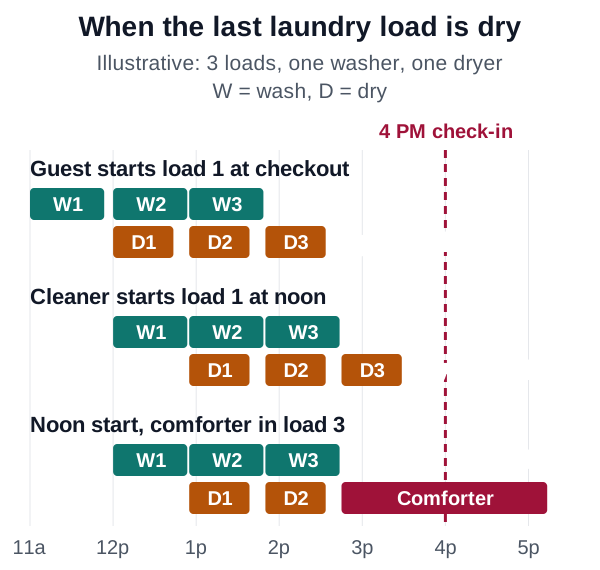
A guest who started a load gave the turnover a head start: the first wash ran from checkout.
Whirlpool says a normal wash usually takes 50 minutes to an hour, and Maytag says a large load of towels and blankets "can take up to three hours" to dry. Comforter estimates vary with the fill and the dryer: Maytag says "around two to three hours" and Whirlpool "40 to 50 minutes."
Loads queue, too. "A full load might be simply one queen set," says Consumer Reports. With one washer and one dryer, that can mean a load per bed, and once towels or a comforter go in, the dryer becomes the bottleneck.
The illustrative timeline below uses those maker figures.
Trash
Airbnb's announcement covers indoor bins and taking trash off-site, and no page we read mentions an outdoor bin on the property. One host on r/airbnb_hosts reports the editor flagged a request to take trash out. I'd plan for the outside bin to be turnover work unless the editor accepts the wording.
The host mentioned above describes guests on a two-week stay letting trash overflow next to the bin (r/airbnb_hosts). Airbnb's guest ground rules ask guests to "put their trash in designated receptacles and be mindful of excessive amounts of trash."
How I'd measure it
Before changing any price, I'd time one real turnover with the chores left undone, logging hands-on and machine minutes separately. One is paid time; the other decides when the place is ready.
Fix laundry first: spare sets take it off the clock
With enough linens to make every bed from clean stock, the used set can be washed later or off-site, and laundry stops deciding when the place is ready.
A hotel trade publication, Hotel Management, says four sets has been suggested as the optimal level for hotels and resorts. It also quotes an executive housekeeper: "An average turn for our portfolio is three." Rental software vendor Hostaway says "at least three sets of linens per bed," and four for high-turnover rentals.
In a thread on cleaning costs, one commenter suggested a flat turnover fee plus laundry paid per set, since laundry is where time hides. The same commenter suggested a written checklist so host and cleaner price the same job (r/airbnb_hosts). We found no reliable US prices for off-site laundry services.
Before raising any fee, I'd buy the extra set per bed. A second cleaner can't make the dryer finish sooner, and a spare set means the beds don't wait for it.
Should you raise your cleaning fee?
If the turnover costs more, pay for it, but decide where the money shows up.
Airbnb's cleaning fee guide says the fee should cover cleaning, "not as a way to earn extra money," and that guests hold fee-charging listings to "a higher standard of cleanliness." Its guest ground rules say cleaning fees "are only meant to cover the cost of standard cleaning between reservations (laundry, vacuuming, etc.)." Its host ground rules already put laundry, trash and "dirty dishes" on the host.
Commenters in one Reddit thread read it the same way. Under the Paris host's post, several replies asked, in different words, what the cleaning fee had been for. The top reply argued that if hauling out trash and recycling takes that long, it's not really reasonable to ask of a guest anyway (r/airbnb_hosts).
Airbnb's advice once ran the other way. An archived 2022 copy of its fee guide told hosts who wanted guests to load the dishwasher or strip the beds to "consider charging a very minimal cleaning fee." It warned: "With a higher fee, guests may expect to just walk away from your space at checkout as they would a hotel room." A November 17, 2022 update removed it.
The new policy ends that trade. It lands hardest on hosts like one in an Airbnb Facebook group post whose only request was dishes and who charges no cleaning fee.
Analyzing Airbnb and Vrbo data, AirDNA found that 89% of US listings charge a cleaning fee, and it puts the average US Airbnb cleaning fee in 2025, counting only listings that charge one, at $161.10 per stay (AirDNA).
Under Airbnb's single service fee, which it says is "mandatory for most hosts," most hosts pay 15.5% (Airbnb's service fee help), a fee that "applies to your nightly price and any fees you add, like a cleaning, pet, or extra guest fee" (fee explainer). Hosts had until September 15 (October 13 for hosts who live in the European Economic Area or Switzerland) to adjust prices for it, so a fee change now comes on top.
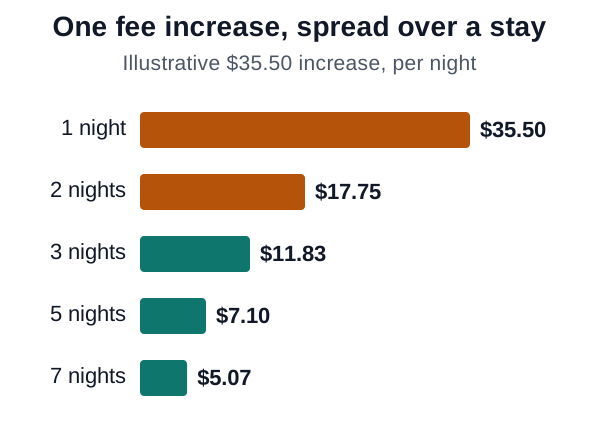
Our arithmetic: divide what you want to keep by 0.845, so keeping an illustrative $30 more takes about $35.50, and the nightly rate carries the same fee.
Guests compare totals: the price shown in search "includes any fees" (Airbnb's pricing help), a display standard worldwide since April 2025. Price can "heavily influence how a listing appears in search results," and the algorithm weighs total price (Airbnb's search help), which a cleaning fee raises (fee guide).
Choosing between the cleaning fee and the nightly rate changes which stay lengths pay more, and short stays feel a fee most, as the illustrative chart below shows.
Airbnb's cleaning fee help lets you set a lower "Short-term stay cleaning fee" for 1- or 2-night bookings, and your minimum stay settings decide how many you take.
One host with a remote three-story cabin says the cleaner charges $320, the listing shows a $150 cleaning fee and the rest goes into the nightly rate (r/airbnb_hosts).
If most of my stays ran a week, I'd keep the cost in the cleaning fee, where it adds little per night. If most were 1 or 2 nights, I'd weigh the short-stay cleaning fee and the nightly rate together, changing one number at a time.
US maids and housekeeping cleaners earned a median $17.07 an hour in 2025 (Bureau of Labor Statistics data via O*NET OnLine). That's employee pay; a cleaning company bills its own rate.
I wouldn't charge guests for skipped tasks: Airbnb's guest ground rules bar it, and its house rules policy generally rules out fines.
Buy time instead of labor: widen the turnover window
If the machines can't finish inside the window, widen it. One reply in the Paris thread told the host their turnaround time was their own choice (r/airbnb_hosts).
Moving checkout earlier or check-in later buys hours, though guests may like it less. Guests "should complete checkout, including key return, by the designated checkout time" (guest ground rules).
A guest in one thread said a cleaner running the dishwasher could cost the next guest an early check-in, so they don't mind starting it (r/AirBnB). Airbnb's early check-in help tells guests an early check-in or late checkout might bring "extra charges, like if they need to hire additional cleaners."
For a bigger buffer, Airbnb's preparation time setting offers none, one or two whole nights before and after each reservation (availability guide). We found no hours-based option for homes on its pages. Airbnb also says requirements like preparation time can keep a listing out of some guests' search results (booking settings help).
On big-house weekends with several beds and comforters, I'd rather keep the night before unbooked than run a same-day turn that depends on the dryer. Preparation time applies before and after every reservation on the listing, so I'd block that single night by hand instead.
What I'd agree on with a cleaner before the first checkout under the new rules
I'd put the new task list, the time it takes and the rate in writing, because the extra work lands inside the same window. The host in the Australian Facebook group adds that the change will leave homes messier, meaning less changeover time and lost nights (Airbnb Host Australia Facebook group).
I'd agree on:
- The new tasks, and who starts which machine
- What happens if dishes or trash wait a day
- The rate: flat, hourly, or flat plus laundry per set
- Spare linen sets and supplies
- Photos on arrival
- What counts as an excessive mess, and how it's reported
Guests shouldn't leave a place needing "excessive or deep cleaning (moldy dishes, soiled carpets, stains from pets, etc.)" (guest ground rules). Host damage protection reimburses extra cleaning "in certain cases," like stains, pet accidents and smoke odor, and excludes "Cleaning associated with normal check-out tasks (ex: laundry, dishes, or trash removal)." So ordinary dirty dishes are turnover work, while a mess that needs deep cleaning, like moldy dishes or stains, can be a case for a damage claim.
On our reading, a higher cleaning fee also raises the bar for those claims. Airbnb's Host Damage Protection Terms pay "only cleaning costs in excess of cleaning fees paid to or charged by a Host," and the Terms of Service limit a guest damage report to "cleaning costs in excess of the Host's cleaning fee." Requests are due "Within 14 days of the responsible guest's checkout" (Host damage protection help), so the cleaner's photos need to reach you well before then. None of this guarantees an outcome.
If a rushed turn leaves the place less than clean, the next guest may ask for a refund.
Rewrite your Airbnb house rules and requests before November 20
Any request that lives only in old checkout instructions, saved messages, house manuals or door signs needs to move into House rules and requests, or go. Your checkout instructions "no longer appear in a separate tab" (announcement), and the house rules policy bars new requests "after booking, including by message, signs in the home, or in person."
Airbnb's checkout guide adds turning off lights to the examples above. Expect the editor to flag anything closer to cleaner work.
Your scheduled checkout message can remind guests of listed requests. Airbnb tells guests that hosts "may remind you about checkout expectations through messages or signs," but instructions "should match what's included in your reservation details" (guest checkout help).
If a property management system pushes your rules, Rental Scale-Up, an industry outlet owned by PriceLabs, advises checking that fixes made on Airbnb aren't overwritten. Quiet hours belong in the standard rule; see our noise complaint protocol.
What I'd do before November 20
Today, I'd open the listing editor and see what it flags. This week, I'd time one turnover with the chores left undone. Before the first checkout under the new rules, I'd buy a spare linen set per bed and agree on the new deal with the cleaner. The policy details are in our Update on the house rules policy.
Common questions
Is there a petition against Airbnb's new checkout rules?
Yes. "Keep Self-Catering Self-Catering," a Change.org petition started in the UK on October 21, 2026, had more than 7,000 verified signatures when we checked on October 23. Its main asks are letting hosts require guests to wash up and to use designated bins at the property. It supports Airbnb's efforts to prevent unreasonable demands such as stripping beds and laundering linen. When we checked, we found no Airbnb statement about changing the policy, which still applies to reservations booked on or after November 20, 2026.
Can I still ask Airbnb guests to load the dishwasher?
Airbnb's own example stops at asking guests to put used dishes in the sink, and no current Airbnb page we read mentions dishwashers. One host in a Facebook group reports the listing editor flagged a request to load and start the dishwasher, and that support called it policy. I'd check how the editor treats your wording, and I wouldn't build a same-day turnover around it.
Can I charge an Airbnb guest who leaves dirty dishes or full trash?
No. Airbnb's ground rules for guests say hosts may not charge fees for skipped cleaning or checkout tasks, and its house rules policy generally rules out fines. A place left needing excessive or deep cleaning, like moldy dishes or pet stains, is a different case for the Resolution Center. Host damage protection doesn't cover normal checkout cleaning such as laundry, dishes or trash removal.
Do the new Airbnb house rules apply to reservations already booked?
No. The policy applies to reservations booked on or after November 20, 2026. Airbnb's help page says the house rules and requests on your listing when you received a reservation still apply to it. Even on those older bookings, Airbnb's ground rules already bar fees for checkout tasks a guest skips, so an old chore list can't be backed with a charge.
Should I raise my Airbnb cleaning fee or my nightly rate?
It depends on how long your stays run. Airbnb's 15.5% host fee, paid by most hosts, applies to both, and guests see one total either way, so the choice decides which stay lengths pay more. If most of my stays ran a week, I'd use the cleaning fee. If most were 1 or 2 nights, I'd look at the short-stay cleaning fee and nightly rate together.
Will Airbnb penalize my listing for an old checkout chores list?
It can. Requests that break the policy are highlighted in the listing editor, and Airbnb says it will email you with tips and a chance to appeal. If an issue goes unresolved, guests may see an alert on the listing, and persistent violations can reduce search visibility. Listings with repeated low ratings from unreasonable requests may be removed.
Sources
Show sources (54)Hide sources
Read next
Automation & Operations
Should you automate Airbnb guest messages? What I'd schedule and what I'd write myself
Cina ·
Guest Experience
Screening Airbnb guests: which red flags matter, and whether to keep Instant Book on
Cina ·
Pricing & Revenue
Guest cancels or leaves early on Airbnb? What you keep, and when I'd refund anyway
Cina ·


