Pricing & Revenue
Guest cancels or leaves early on Airbnb? What you keep, and when I'd refund anyway
A guest's plans changed, and they want to cancel or cut the stay short. Here's what your Airbnb policy leaves you, and when I'd refund more anyway.

On this page
- What Airbnb pays you when a guest cancels
- Is Strict gone? What changed in 2025 and 2026
- A guest wants to leave early: cancel, or shorten the stay?
- When I'd refund anyway, and how much
- Emergencies, illness and travel insurance
- Settings that protect peak weeks before the next cancellation
- If the booking came through Vrbo or Booking.com
- The record I'd keep
- Three moves before the holidays

"Our plans changed. Can we cancel?" Or, mid-stay: "Can we leave Sunday instead of Wednesday?"
When an Airbnb guest cancels or asks to leave early and nothing is wrong with the place, the cancellation policy shown on that reservation decides what you keep. Anything more is your choice, paid through Airbnb.
If the guest is unhappy with the place, see what I'd do when a guest asks for a refund. RentalWe's editors read every cited Airbnb page on October 20, 2026; this is how they read then, not legal advice.
Key Takeaways
- The policy on the reservation decides your payout, not your setting today.
- Illness or a canceled flight doesn't override that policy. Any extra refund is your call.
- Accepting a request to shorten a booking of under 28 nights refunds the dropped nights. Declining keeps your policy in charge.
- If a guest asked to leave early, I'd explain the policy and let them decide. Only after they'd canceled on their own would I offer to refund nights that rebook.
- Strict is invitation-only for short stays. Date-specific policies and a non-refundable option can help protect peak weeks.
What Airbnb pays you when a guest cancels
Your payout depends on the policy on the reservation and how far before check-in the guest cancels. "The cancellation policy that was set when you received a reservation will still apply to that reservation," says Airbnb's page on changing your policy. Airbnb refunds the guest automatically and sends any payout you're owed 24 hours after the scheduled check-in. If it's your first time hosting, Airbnb "may hold the payout until 30 days after the reservation was confirmed."
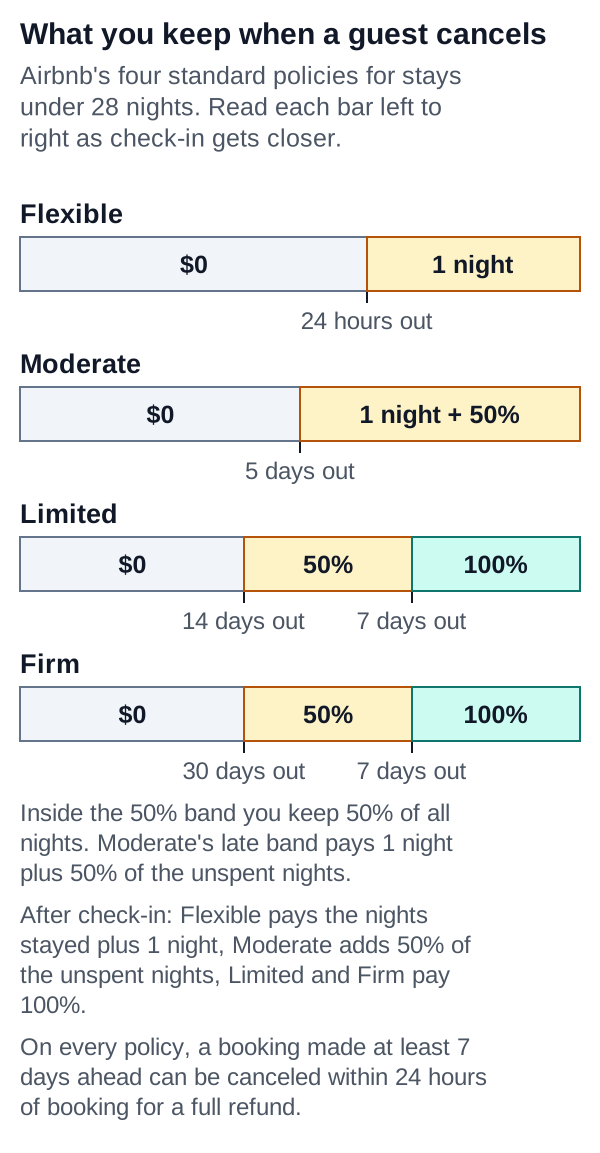
For stays of 27 nights or fewer, most hosts choose from four policies, and Airbnb's US, UK and Australian help pages list the same ones. Limited is available for bookings made from October 1, 2025 (Airbnb cancellation policies).
- Flexible. Free until: 24 hours out. You keep if canceled later: First night. You keep after check-in: Nights stayed plus one night.
- Moderate. Free until: 5 days out. You keep if canceled later: One night plus 50% of unspent nights. You keep after check-in: Nights stayed, one more, and 50% of unspent.
- Limited. Free until: 14 days out. You keep if canceled later: 50% from 14 to 7 days out, then 100%. You keep after check-in: 100%.
- Firm. Free until: 30 days out. You keep if canceled later: 50% from 30 to 7 days out, then 100%. You keep after check-in: 100%.
Every standard policy for stays under 28 nights also has a 24-hour window: guests can cancel "for a full refund including taxes for up to 24 hours after the reservation is confirmed, as long as the reservation was confirmed at least 7 days before check-in" (Airbnb cancellation policies).
A full refund means "the price that you set for your listing including taxes" (Airbnb cancellation policies). For bookings from April 21, 2025, the cleaning fee is refunded in full only inside the free window; after that, it follows your policy.
In Key Data's analysis of US Airbnb bookings, 16% of Q4 2024 cancellations came 7 to 14 days before check-in and 23% came 14 to 30 days out, before Airbnb's October 2025 policy changes and its 2026 move from Strict to Firm.
Stays of 28 nights or more follow your long-term policy. Under long-term Firm, a guest gets a full refund only by canceling 30 or more days before check-in; after that, you're paid for nights spent plus 30 more, or all remaining nights if fewer. After check-in, a monthly guest generally owes the next 30 nights, or the rest of the stay if fewer remain (Airbnb monthly stay cancellations, Airbnb, modifying a reservation), though the policy page says a guest who cancels after check-in gets no refund, so check the reservation details.
Airbnb also tells hosts to "be sure that your selected cancellation policy complies with local rules and regulations" (Airbnb cancellation policies).
Is Strict gone? What changed in 2025 and 2026
For stays under 28 nights, mostly. Airbnb's policy page lists Strict and both Super strict policies as "only available to certain hosts by invitation from Airbnb." Its August 2026 shareholder letter says "We migrated eligible listings from Strict to Firm cancellation policies, helping hosts attract more bookings." That's Airbnb's claim, without figures.
One host reports a rougher result. A US host with 280 reviews quoted a July 2025 Airbnb email saying Strict was "going away" for new listings, and said in September 2026 that their cancellation rate rose from 3% to 22% on Firm, with guests canceling about 35 days out.
Strict remains a long-term policy for stays of 28 nights or more. If I were checking today, I'd confirm the setting under Listing editor, then Your space, then Cancellation policy, and read the policy line on each holiday booking.
A guest wants to leave early: cancel, or shorten the stay?
With no complaint, the policy on the reservation still decides. What changes the money is how the stay ends.
If the guest cancels after check-in, Airbnb's help page says "they must vacate your place immediately, and the terms of your cancellation policy will still apply." On a short stay under Limited or Firm, that means no refund.
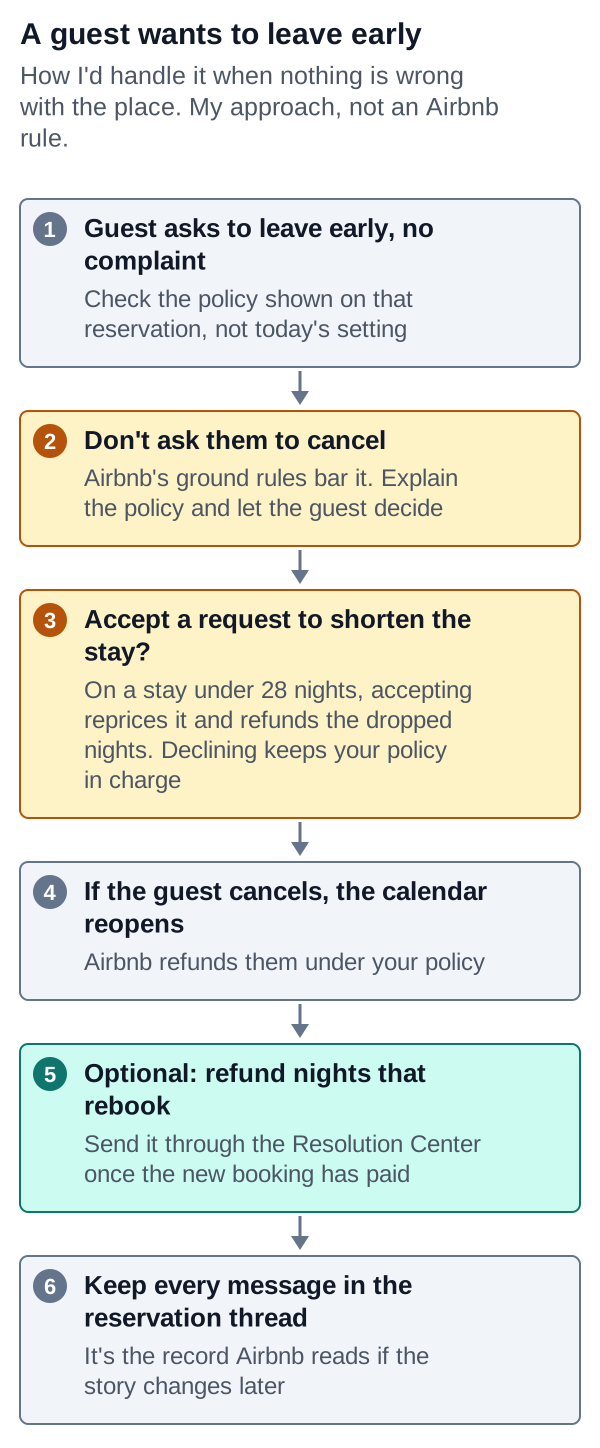
If the guest asks to shorten the stay with a trip change request, even mid-stay, Airbnb's trip change page says "If you accept the changes, they'll be applied automatically, and your guest will be charged or refunded if necessary." On a stay of 27 nights or fewer, Airbnb recalculates the price of the shorter stay and refunds the guest the difference, so in practice the dropped nights don't go through your cancellation policy.
If you'd rather your policy decided it, decline. The same page says "You can always decline a trip change request with no consequences." If the guest then cancels, your policy applies to the nights left.
In an October 2025 Community Center thread, a host in New Zealand on Strict said a guest shortened a stay more than 7 days before check-in, and "the system auto-calculated a 100% refund for the removed nights," where canceling would have kept 50%. The host put the cost at $1,000 and said an Airbnb Senior Case Manager called it by design.
When a new host in Australia asked about a 25-night guest leaving after 9 nights (October 2026 thread), a host of 16 years said they never accept alterations that shorten a stay, with a bad review once or twice at most in dozens of cases.
If the payout already went out, "Their refund amount is deducted from your future payouts until the full amount is collected" (Airbnb, your payout if a guest cancels).
Monthly stays differ. If one is shortened to 27 nights or fewer, the guest owes "the following 30 days of payment from the day of the alteration, or until the end of the reservation if less than 30 days remain" (Airbnb, modifying a reservation). With less than 30 days' notice, you can enforce or waive your policy; with more, you won't see the option to accept or decline.
The ground rule: don't ask the guest to cancel
Airbnb's ground rules for hosts are blunt: "Hosts may not ask the guest to cancel the reservation on their behalf." If a guest asked me how to leave early, I'd explain what their booking's policy says and let them decide. I wouldn't ask them to cancel.
Some guests leave, or say they won't arrive, but never cancel. Hosts in a May 2026 thread advised not rebooking those dates while the reservation is active. Airbnb's help page on guest no-shows tells hosts that "If your guest is unresponsive, you can contact Airbnb to report the no-show." None of the Airbnb help pages cited here say what happens to your payout or the dates when a guest leaves or doesn't arrive without canceling.
When I'd refund anyway, and how much
I'd choose between three options. For most early leavers with no complaint, my default would be the second.
1. Enforce the policy as written. It's what the guest agreed to, and Airbnb's Major Disruptive Events Policy says "any refunds outside of the reservation's cancellation policy are at the host's discretion." I'd send a short, warm reply that mentions travel insurance.
2. Refund the nights that rebook. Several hosts offer this up front. One former host in a May 2026 thread said "I think the guests always thought this was fair."
In July 2026 a UK Community Champion (a forum role, not Airbnb staff) gave a similar script to a host in the UK whose guests had left a night early. The Champion suggested saying a refund wasn't possible because a replacement booking was unlikely that late, "but if you do a replacement booking you'd be happy to look at a refund" (Community Center thread).
I'd be more careful. Nights can't rebook while the reservation still covers them, and a host "may not encourage the guest to cancel the reservation" (Airbnb Host Cancellation Policy). So I'd raise it only after a guest had canceled on their own, then refund any nights that rebook once the new booking has paid.
That money goes through the Resolution Center, "the only way for a host to send money to a guest" once a stay has started. Hosts "should submit refunds or requests within 60 days after checkout," and "Once you send the money, the transaction is considered final" (Airbnb, refund your guest). Airbnb's service fee page says the guest's fee comes back inside the free window "or if your host decides to refund you in full after you cancel." It says nothing about partial refunds, so I wouldn't promise any of it.
3. Refund in full. I'd consider it when the dates were held only days and check-in is weeks off, or as goodwill to a long-term guest. In an October 2026 thread, a 5-year host's top reply told a new host whose month-long guest asked to cancel days after booking to refund it all. In another, the top reply called refunding part or all of a near-year guest's last month reasonable, though not required.
Before check-in, the Resolution Center won't let you send money until the reservation is canceled; for a full refund, "The host can contact Airbnb to have our Community Support team refund the guest in full" (Airbnb Resolution Center help). Whatever I offered, I'd write it in the reservation thread. Airbnb's ground rules say "Hosts should honor their promises to refund or compensate guests."
Emergencies, illness and travel insurance
A personal emergency doesn't change the policy. Airbnb's Major Disruptive Events Policy lists "Unexpected injury or illness," flight cancellations and canceled events as not covered, and anything outside its covered events "remains subject to the host's cancellation policy for the listing." When it does apply, guests can get "a refund, travel credit, and/or other consideration," and you aren't paid for those nights.
Insurance is the guest's tool. Guests living in the US, the UK and some other countries "can purchase travel insurance on the checkout page" (Airbnb UK); Australian guests are offered "stay protection insurance" (Airbnb Australia). If a US guest bought Airbnb's travel insurance and the reason is covered, trip interruption cover reimburses unused nights "if your trip is delayed or cut short for a covered reason, such as illness or injury" (Airbnb US travel insurance).
In July 2026 a Community Champion told a host in Sweden whose guests left on arrival night: "No, you do not have to offer a refund simply because the guests chose to leave early due to a personal emergency" (Community Center thread). Most replies to an October 2026 medical-emergency thread said no, the top one kindly; a few suggested small gestures, like refunding the cleaning fee.
If I were saying no, I'd keep it to two lines:
I'm so sorry, and I hope everyone is OK. The cancellation policy on your booking still applies to the unused nights, but travel insurance may cover them if you have it.
Settings that protect peak weeks before the next cancellation
Pick the policy for the whole year, then tighten only the dates that matter.
Date-specific (dynamic) policies
"You can apply different cancellation policies to specific date ranges right from your calendar," says Airbnb's help page, which also calls them dynamic policies. The policy follows the check-in date, and "Existing bookings keep the policy in effect when they were made." It covers stays under 28 nights; your long-term policy doesn't change.
The feature rolled out from late 2025, so it may not have reached your account yet. A US Community Champion wrote on December 31, 2025 that hosts on channel managers couldn't see it, then in January shared another host's tip: extend a stricter Christmas policy two days either side.
Non-refundable option
Airbnb's non-refundable option lets guests on stays under 28 nights pick your standard rate or a discounted one, "typically 10% off the base price." After any free period, "you keep your entire payout for all nights booked," though it's "still subject to the 24-hour cancellation period" (Airbnb cancellation policies). One host on Moderate with a 10%-off option said about 80% of guests chose it (June 2026 thread).
Booking window
In an October 2026 Thanksgiving thread, one host said moving from a 6-month to a 12-month calendar raised bookings but took far-ahead cancellations from zero to about 25%, so they went back. Another, in a high-demand area, said a Christmas week canceled a month out only rebooks if they drop the rate, "often 20-30% lower." I'd keep peak weeks closed until their policy was set.
Guests do value flexibility, though. In its guide to choosing a cancellation policy, Airbnb says 44% of guests in its 2024 survey of travelers in 11 markets called free cancellation one of their top needs.
Airbnb extended cancellation (US listings)
Where Airbnb extended cancellation is offered, guests pay Airbnb a fee to cancel for a full refund up to 24 hours before check-in, and "you'll still be paid according to your cancellation policy if your guest cancels" (Airbnb extended cancellation help). That can be $0 if they cancel inside your free window. As of October 20, 2026, Airbnb lists the US and 16 other countries, not the UK or Australia.
Eligible listings on Moderate, Limited, Firm or Strict are opted in automatically, and a guest's extended cancellation has "no impact on your cancellation rate or Superhost status" (Airbnb extended cancellation help). To opt out, open Cancellation policy, then Additional policy options, and deselect "Airbnb extended cancellation" (Airbnb opt out steps).
Two host reports show how it has played out. In September 2026 one host said a guest who'd bought it canceled two days before a Labor Day stay and the host "got paid as if they had stayed," though their policy isn't stated. A host in Canada on Firm saw a $0 payout in April 2026 after a guest with the add-on canceled less than 24 hours before check-in, when it no longer applies. In June the host said Airbnb "issued my full payout via a manual adjustment" (Community Center).
If a payout looked wrong, I'd check the booking confirmation email, which notes the add-on, and contact Airbnb with the policy line from the booking.
If the booking came through Vrbo or Booking.com
Vrbo and Booking.com have their own policy menus and refund tools.
Vrbo has seven standard policies, and the shared names mean different terms: Vrbo's Firm is a full refund until 60 days out, then 50% from 60 to 30 days. A custom refund "must be equal to or greater than the amount required by your selected cancellation policy." Guests "cannot cancel their own reservation after check-in," so for an early leaver you'd send a refund without canceling, and "the guest can still leave a review" (Vrbo refund page).
On Booking.com, if you use Request to cancel reservation, available up to 48 hours before check-in, and waive the fee, the booking is canceled free of charge with no commission. Unlike Airbnb, it says: "If you want your cancellation policy fee to apply, ask the guest to cancel through their confirmation email, their Booking.com account, or Customer Service." One host in the Thanksgiving thread blocks holidays on Airbnb and lists them on Booking.com as prepaid and non-refundable.
The record I'd keep
The reservation thread is your evidence. In October 2026 a tiny-house host said a months-long guest messaged that he was leaving because of "a change in my circumstances," then told Airbnb about roaches. The hosts pointed Airbnb to his messages, and it didn't accept his explanation.
In the thread, I'd keep:
- The policy line on the booking
- The guest's own words about why they're leaving
- Any refund offer and its terms
- Any rebooking that triggers a refund
I'd log date-specific policy changes myself, too. In July 2026 a host in the Netherlands found 61 reservations carrying Limited and couldn't tell why, because the activity log showed only "Cancellation policy updated."
A guest who cancels before the day of check-in can't review you, and you can't review them. On check-in day or mid-stay, Airbnb says reviews are possible for "certain reservations."
Three moves before the holidays
Before the next holiday, I'd check the live policy on each listing and every holiday booking. I'd set a date-specific policy for peak dates or add a non-refundable option, and decide on extended cancellation for any US listing. And I'd settle my early-leaver rule now, so any offer goes into the reservation thread without a scramble.
Minimum stay settings handle the rest of the calendar, and Airbnb's new multi-listing calendar, rolling out to hosts with 6 or more listings in the coming months, is set to change cancellation policies across several listings at once.
Common questions
Do I get paid if a guest cancels on Airbnb?
It depends on the policy on the reservation and the timing. On a stay under 28 nights, a cancellation inside the free window pays you nothing. After it, Limited and Firm pay 50% of all nights, then 100% inside 7 days; Moderate pays one night plus 50% of the rest, and Flexible the first night. Bookings made at least 7 days before check-in can also be canceled free within 24 hours of booking. Monthly stays follow your long-term policy.
Does an Airbnb guest get a refund for leaving early?
Only what the policy on the booking allows. If they cancel after check-in on a short stay, Limited and Firm give no refund, while Flexible and Moderate return part of the unspent nights. If you accept their request to shorten a stay under 28 nights, Airbnb refunds the dropped nights. You can decline that request, and any extra refund is your choice, sent through the Resolution Center.
Can I still choose Airbnb's Strict cancellation policy?
For stays under 28 nights, Airbnb lists Strict and both Super strict policies as available only to certain hosts by invitation. In August 2026 it reported moving eligible listings from Strict to Firm. Most hosts now choose among Flexible, Moderate, Limited and Firm. Strict is still offered as a long-term policy for stays of 28 nights or more.
Can I set a stricter Airbnb cancellation policy for holidays?
Yes, if the feature has reached your account. Airbnb's date-specific (dynamic) cancellation policies let you select dates in your calendar and apply a different policy to stays that check in on them. Bookings you already have keep their policy. Because the check-in date decides, I'd extend a holiday policy two days either side.
What is Airbnb's extended cancellation option, and does it cost me money?
It's a paid add-on that lets guests cancel for a full refund up to 24 hours before check-in. As of October 20, 2026, Airbnb offers it in the US and 16 other countries, not the UK or Australia. Airbnb refunds the guest, and you're paid according to your own policy, which can be nothing if they cancel inside your free window. You can opt out in your cancellation policy settings.
Sources
Show sources (47)Hide sources
Read next
Pricing & Revenue
Dynamic pricing tools and the market average: when to override them
Cina ·
Pricing & Revenue
Minimum stay settings: when to hold firm and when to bend
Cina ·
Pricing & Revenue
US short-term rental occupancy, ADR & RevPAR statistics (2026)
Cina ·


