Guest Experience
Guest asking for a refund on Airbnb? What I'd do when I doubt the claim
When a guest wants money back for a stay they say was dirty, broken or not as listed, Airbnb usually has the final say, not me. So I'd reply fast, fix what I can and keep the record.

On this page
- Reply within the hour, ask for specifics, offer a fix
- What Airbnb's refund policy covers, and what it takes from your payout
- Can Airbnb refund the guest without asking you?
- Safety claims run on a different track
- Dirty, broken or not as listed? How I'd check without accusing
- Fix, partial refund or refund the unused nights: how I'd decide
- Never trade a refund for a review
- Already refunded by Airbnb? Send the record and escalate
- If the booking came through Vrbo or Booking.com
- The record I'd build before a guest complains
- Habits that hold up, and one task for your next turnover

"The place wasn't clean." "The A/C doesn't work." "It isn't what the listing showed." Then: "I want a refund." When I doubt what I'm reading, my instinct is to argue.
I've hosted and co-hosted for five years and manage 60 short-term rental units today, and I've come to think arguing is the wrong job. On Airbnb, the host usually isn't the judge.
When a complaint counts as a Reservation Issue, Airbnb decides whether the guest gets money back and how much, weighing factors that include "the strength of evidence provided," and any refund comes out of your payout (Airbnb refund policy). After safety, I'd put my effort into answering fast and building that evidence. For bites and pests, see how to handle a guest who says they were bitten.
Key Takeaways
- If a complaint counts as a Reservation Issue, Airbnb decides the refund, not you, and takes it from your payout.
- Reply within the hour, ask for a photo or video, offer a fix, and keep it all in the Airbnb thread.
- Treat a gas smell, a carbon monoxide alarm or sparking wiring as real: everyone out, then call 911 from a safe distance.
- Dated turnover photos, the message timeline and repair reports help, but they don't guarantee your payout back.
- Don't offer money for a good review or for no review. Airbnb's Reviews Policy bars both sides.
Reply within the hour, ask for specifics, offer a fix
I'd reply with the next step and a time, ask for a photo or short video of the specific problem, and offer the fix: a cleaner, a technician, a replacement, or a visit in person. I'd keep all of it in the Airbnb thread, which Airbnb also tells guests to use "so there's a record" (Airbnb guest help).
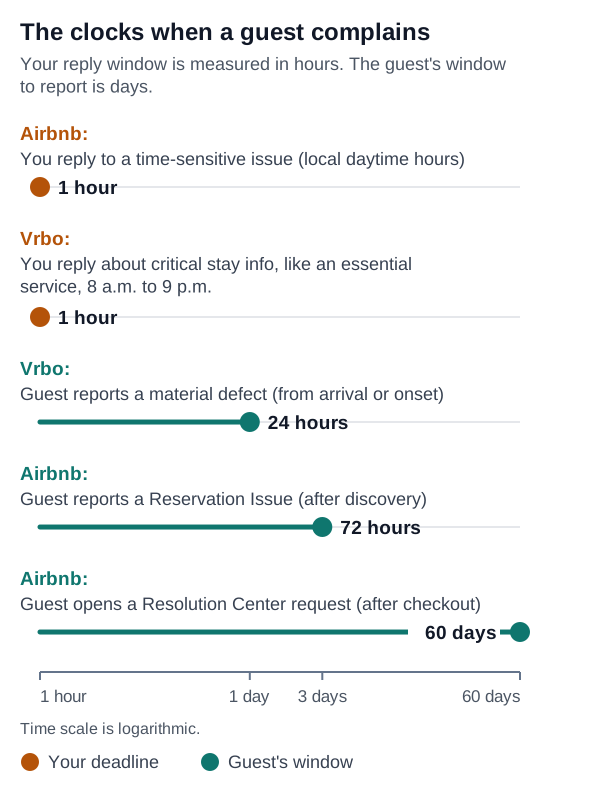
For a time-sensitive issue during a stay, Airbnb's ground rules say "hosts are expected to respond within 1 hour to guest messages received during local daytime hours" (Airbnb ground rules). If you don't answer, Airbnb "may provide immediate assistance to guests who are facing a trip issue."
I wouldn't write "that's impossible," and I wouldn't confirm conditions I haven't seen: the refund policy names "confirmation of the conditions by the host" as one kind of evidence (Airbnb refund policy). By our reading, an apology that reads as an admission can count against you.
A first reply might read: "Got it, and thank you for flagging it straight away. [A cleaner / A technician] can be there by [time]. So they know exactly what to look at, could you send a photo or short video of [the issue] in this thread?" It's the same first-hour habit from the noise complaint protocol.
What Airbnb's refund policy covers, and what it takes from your payout
Besides host cancellations and lockouts, Airbnb's Rebooking and Refund Policy covers homes that aren't habitable at check-in or are significantly different than advertised. When it applies, it "takes precedence over the reservation's cancellation policy," and the host "will receive no payout or will have their payout reduced by the amount refunded to their guest" (Airbnb refund policy). The table quotes that policy unless a row names another page.
- Not habitable at check-in, "including but not limited to" not "reasonably clean and sanitary" or with "safety or health hazards". What it means for you: By our reading, Airbnb decides whether a mid-stay or after-checkout claim qualifies.
- An advertised amenity that "is not present or does not function (ex: pool, hot tub, major appliance, heating, and air conditioning systems)". What it means for you: Broken A/C or heating you advertised can count.
- AirCover for guests "doesn't include more minor inconveniences, like a broken toaster" (AirCover for guests). What it means for you: "The heating is not working in winter" is one of its covered examples.
- Guests have "72 hours after discovery" to report; Airbnb "may allow for late reporting" if the guest shows reporting on time "was not feasible". What it means for you: The clock starts when the guest notices.
- Requests "should be supported" by evidence "such as photographs, videos, or confirmation of the conditions by the host". What it means for you: By our reading, photos help but aren't strictly required, and your own words can count as evidence.
- The guest "must notify the host and try to resolve" it first, "whenever feasible". What it means for you: By our reading, your message thread becomes part of the record.
- Factors include severity, impact, "the portion of the stay affected, whether the guest vacates the accommodations, other mitigating factors, and the strength of evidence provided". What it means for you: Evidence is one factor among several.
- Issues "caused by the guest, co-travelers, or their invitees or pets are not covered". What it means for you: Damage the guest caused doesn't count.
Airbnb's Terms (updated February 5, 2026) also cut your pay "by any other reasonable costs we incur as a result of the cancellation" (Airbnb Terms). If you've already been paid, they let Airbnb recover a refund from "your future payouts," and if Airbnb expects to refund the guest, it may hold your payout "until a refund decision is made." Reported issues "may contribute to" account restrictions (Airbnb account restrictions). On the guest's side, the refund policy says a fraudulent request "may result in account termination" (Airbnb refund policy).
The policy has been effective since February 6, 2025. RentalWe's editors (the "we" in this article) read these pages on October 14, 2026. Check the current versions; this isn't legal advice.
Can Airbnb refund the guest without asking you?
Yes. The policy says, "In most circumstances we will attempt to confirm a guest's reported concern with their host," so not every time (Airbnb refund policy), and hosts agree that "Airbnb Payments may refund the Guest in accordance with the Terms" (Airbnb Payments Terms).
Hosts "can also dispute a guest's assertion of a Reservation Issue by contacting us" (Airbnb refund policy), but we found no published deadline or format for that dispute. Airbnb's Resolution Center page does say "For mediation requests, you only have 1 hour to respond," without saying whose clock that is (Airbnb Resolution Center), so I'd answer anything from Airbnb fast. And a host's "no" doesn't end it: "If your host doesn't reply or says no, you can ask Airbnb for help," Airbnb tells guests (Airbnb guest help).
A host on AirHostsForum posted in September 2026 that a guest reported a smell at night and a gas leak by morning, and the booking was canceled before the host arrived. The host found only "a faint smell from some cooking" the guest had done and says "Airbnb made no attempt to contact me and refunded the guest in full." Airbnb then suspended the listing and required a paid gas engineer's confirmation before it could return (AirHostsForum). One reply sided with Airbnb: "not worth the risk."
Support may also suggest you pay. A host on AirHostsForum posted in July 2026 that support said there was "NO OBLIGATION" to refund but recommended refunding something "in the spirit of Airbnb community" (AirHostsForum). Outside its refund policies, Airbnb's guest page says "A refund outside of their cancellation policy is at the discretion of the host" (Airbnb guest help). I'd treat a suggestion from support as a suggestion and decide on the facts.
Safety claims run on a different track
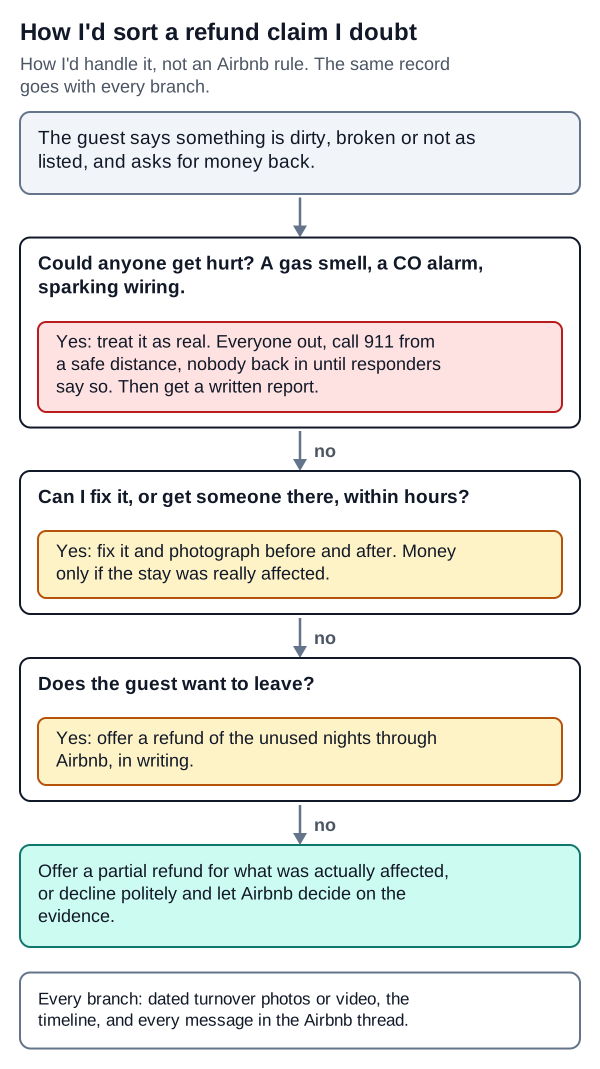
A gas smell or a carbon monoxide alarm is real until a professional says otherwise, and I'd treat sparking wiring the same way. The CPSC's advice when a CO alarm sounds includes "Immediately move outside to fresh air" (CPSC), and federal pipeline-safety guidance for a gas leak says "Leave the area" and call 911 from somewhere "well away from the gas leak" (PHMSA). The CPSC adds: "DO NOT reenter the premises until the emergency services responders have given you permission." So my first message would be: everyone out, then call 911 from a safe distance, and nobody goes back in until responders say so.
Airbnb's Terms say that for "an imminent risk of harm," you "should immediately contact local authorities before contacting Airbnb" (Airbnb Terms). Its safety requirements say hosts "must address known hazards that could cause injury before accepting reservations," and if a host fails to disclose or fix a known hazard, Airbnb "may also cancel upcoming or active reservations, or require proof that hosts have addressed issues before they can accept reservations" (Airbnb safety requirements).
A London host's August 2026 post shows both sides. Within five minutes of a guest reporting a gas smell from the hot water, the hosts told them to stop using it and called a plumber; the family left, and the hosts refunded the first night through Airbnb. The plumber's written report found no leak but a real fault in the water heater exhaust. Airbnb marked the stay "Cancelled by Admin" and zeroed the payout without notice, then agreed to restore it after the hosts escalated to a senior case manager with the timeline, report and invoice (Airbnb Community Center).
If a unit goes offline while you wait for a report, block its dates everywhere it's listed; your channel manager or iCal sync sets the speed.
Dirty, broken or not as listed? How I'd check without accusing
Compare the claim with what you can see now and what you recorded before check-in, and ask rather than accuse. We found no published figure for how often refund claims are false, so I'd treat doubt as a reason to check.
Dirty. I'd send a cleaner or go in person, and compare the guest's photos with dated turnover photos from the same angles. The Lombok case below shows why the angles matter.
Broken. Ask what exactly happens: does the A/C blow warm air, does any burner light? A host with Airbnb's Community Champion badge suggested in a July 2026 thread that a Wi-Fi thermostat lets you check the indoor temperature from afar (Airbnb Community Center). I'd keep remote checks to readings like that.
Not as described. Check the claim against your listing as booked; we suggest screenshotting it after every edit. A listing "must include complete and accurate information" (Airbnb Terms), and Airbnb will ask hosts to remove content where "AI or other digital technology has been used to edit flaws, hide damage, add amenities" (Airbnb ground rules). In the same July thread, a lake cabin host whose profile says Minneapolis described guests who were upset there was no A/C, though the listing said so. The guests then said the basement smelled, left after a couple of hours and asked for half back. Part of the Champion's answer: "Guests don't read listing material," so repeat key facts in your first message. The same reply leaned toward giving the refund or splitting the difference (Airbnb Community Center).
A photo that doesn't match your unit. Airbnb bars "false, misleading, or manipulated information" and "Making false reports, claims, or credit card chargebacks" (Airbnb anti-deception policy). Say what doesn't match, send your own dated photo of the same spot, and let Airbnb draw the conclusion.
Evidence still isn't a guarantee. A Galveston, Texas, host posted in September 2026 that guests twice claimed smoking or bed bugs on their last day; inspections the host paid for found nothing, the host sent Airbnb the report, and Airbnb still issued a partial or full refund (Airbnb Community Center). The host still wrote that most guests are honest.
Fix, partial refund or refund the unused nights: how I'd decide
My rule would be: safety first, then a fix within hours if possible. If the guest wants to leave, I'd offer to refund the unused nights, in writing. If they stay and I doubt the claim, I'd offer a partial refund for what was actually affected, or decline politely and let Airbnb decide on the evidence.
One limit applies: Airbnb's ground rules say "hosts may not ask the guest to cancel the reservation on their behalf" (Airbnb ground rules). So the refund offer is only for a guest who already wants to leave, and the host shortens the stay with a trip change request instead of asking the guest to cancel.
Forum hosts go further: in one of the most-liked replies in the AirHostsForum gas-leak thread, a regular advised hosts "to immediately offer to cancel at no charge" when a guest is unhappy for any reason (AirHostsForum). By our reading, that advice sits close to the ground rule above. Mine would be narrower: a refund of the unused nights for a guest who already wants to leave, because I'd rather refund nights nobody uses than argue about them.
I'd also rather fix than pay. In an October 2026 broken-stove thread, a Community Champion observed that when guests contact customer service, Airbnb "tend to refund 30% for every night that the declared amenity is out of order or missing." That's one Champion's observation; we found no published rule saying so. Another host: "Rather than offer a refund, try to get someone out to fix it asap" (Airbnb Community Center). For small issues, Airbnb's guest page says "A partial refund (ex: cleaning fee) may suit minor issues like unwashed linens" (Airbnb guest help).
Pay only through Airbnb. After check-in, "the only way for a host to send money to a guest is via the resolution center," and "Once you send the money, the transaction is considered final" (Airbnb, refund your guest). Nights are different: you can't use the Resolution Center to "provide refunds for nights," though if a guest cancels after the start date, the host "can send a full refund to the guest in the Resolution Center" (Airbnb Resolution Center help). To shorten a current stay, you send the guest "a trip change request proposing your new dates or price" (Airbnb, modifying a reservation). Against a guest's request, you can pay in full, pay a different amount or decline. Payments outside Airbnb are prohibited (Airbnb Off-Platform and Fee Transparency Policy). Airbnb "may reduce" its own refund "to reflect any refund or other relief provided directly by a host" (Airbnb refund policy). A refund you send stays sent: the London hosts' first-night refund stayed deducted even after Airbnb restored their payout. And if you promise money, hosts "should honor their promises to refund or compensate guests" (Airbnb ground rules).
Never trade a refund for a review
Don't offer money for a review or for silence, and don't let a review threat set the refund. Airbnb's Reviews Policy says "Hosts and guests may not threaten a negative review as a means to obtain unwarranted compensation, refund, or other incentive," and reviews may not be "provided or withheld in exchange for something of value" (Airbnb Reviews Policy).
A guest who leaves early may still be able to review: Airbnb allows reviews for "certain reservations that are canceled on or after the day of check-in" (Airbnb, reviews for homes). And under the Reviews Policy, a review discussing "the facts or legitimacy of a Resolution Center or AirCover claim isn't automatically considered retaliatory."
A Tbilisi, Georgia, host posted in September 2026 that a guest whose plans changed wrote, "You must refund me, or I will tell Airbnb." The host enforced the cancellation policy; the guest then left a 1-star review for dirtiness never raised during the stay, and the case manager wouldn't remove it (Airbnb Community Center). For the process, see how review removal works.
Already refunded by Airbnb? Send the record and escalate
Send Airbnb a short, dated evidence package and keep asking for escalation. It can work, and it can fail.
What I'd attach:
- Dated turnover photos or video from the same angles
- The repair invoice, or the technician's or engineer's written report
- The message timeline from the Airbnb thread
- A screenshot of the listing as the guest booked it
- The reservation code
A Lombok, Indonesia, host posted in August 2026 that a guest asked for a refund after checkout, with photos of dirty rugs and a kitchen, after a four-day stay with no complaint. Support said by phone not to worry; the next day Airbnb charged the refund. After three days and several agents, Airbnb reviewed the host's photos from right before check-in, same angles, with time data, and "issued a full reimbursement of my payout" (Airbnb Community Center). A reply: "Phone conversations are not tangible evidence."
By our reading, if Airbnb's message cites its ground rules for home hosts, you can appeal: the actions Airbnb lists for enforcing those rules include "refunding a guest from a host's payout," and "Hosts may appeal decisions under this policy by contacting us directly or through the link provided to start the appeals process" (Airbnb ground rules). Otherwise, it's a dispute.
If the booking came through Vrbo or Booking.com
Vrbo's guarantee is narrower, but Vrbo can still refund the guest and bill you. Booking.com hands you the complaint first and can invoice you if you don't fix a "material irregularity" and can't show you weren't responsible.
VrboCare "is not a guarantee of satisfaction," and "cleanliness and minor amenities that are not operating properly are not considered material defects" unless they "create a health and safety hazard or violate a Vrbo policy." Disclosed defects aren't covered, and guests should report within 24 hours and ask the host first (VrboCare terms, archived).
By our reading, the Host Terms reach further: under clause 9.9 (10.8 from October 29, 2026), if Vrbo decides "in its sole discretion" that a guest is entitled to a refund, the host will "reimburse Vrbo for any such refunds and for all costs and expenses" (Vrbo Host Terms, archived).
Expedia Group's Host Communication Policy, which applies to Vrbo, wants a reply within 1 hour (8 a.m. to 9 p.m., property time) on check-in day and during the stay to questions about critical stay information, such as essential services, essential amenities or safety, and "Automatic replies do not count" (Expedia Group). Even after a prompt reply, if a significant issue like "a broken furnace in winter" can't be fixed in time, the guest "may still be eligible" for VrboCare. A refund without canceling still lets the guest review (Vrbo Help), and Vrbo's extortion policy binds both sides.
Booking.com "shall always give the Accommodation the opportunity to resolve the complaint" (Booking.com terms). By our reading of clause 2.5.5, if the property "fails to resolve a material irregularity," Booking.com may compensate or relocate the guest and "may invoice the Accommodation" if the property can't show it wasn't responsible. Its Refund Guest button works only after checkout, for Payments by Booking.com bookings, once per booking, and "You'll still pay commission on the original reservation value" (Partner Hub). A review used to blackmail you can be removed, but "we need written evidence" (Partner Hub).
The record I'd build before a guest complains
- A dated walk-through video of every room at turnover, same angles each time. It adds time, so count it in your turnover cost.
- An after-hours contact written in the listing, as a host on AirHostsForum suggested in August 2026.
- A listing that says plainly what isn't there, like no A/C or a sofa bed in the living room, and a first message that repeats it.
- A maintenance log with receipts and service dates for heating, cooling and appliances: the record I'd attach to a dispute.
- Spare batteries, a remote and filters on hand.
Habits that hold up, and one task for your next turnover
Treat safety claims as real, reply within the hour and fix what you can. Give an unhappy guest an easy way out in writing, keep every message and photo where Airbnb can see it, and never trade money for a review.
This week, record a dated walk-through video of each unit at its next turnover, same angles, filed so you can find it by reservation.
Common questions
Can Airbnb refund a guest without the host's permission?
Yes. Airbnb's Rebooking and Refund Policy says that in most circumstances Airbnb will attempt to confirm a guest's reported concern with the host, which isn't every time. If Airbnb decides a Reservation Issue disrupted the stay, it can give the guest a full or partial refund, and the Payments Terms say hosts agree Airbnb Payments may refund the guest. You can dispute the claim by contacting Airbnb.
Can I refuse a guest's refund request on Airbnb?
Yes. In the Resolution Center you can pay the full amount, pay a different amount or decline. Declining doesn't end it: Airbnb's guest help says that if the host says no, the guest can ask Airbnb for help, and Airbnb then reviews the case under its Rebooking and Refund Policy. For issues outside its refund policies, Airbnb says a refund beyond the cancellation policy is at the host's discretion.
How long does a guest have to report a problem on Airbnb?
Under Airbnb's Rebooking and Refund Policy, a guest must report a Reservation Issue within 72 hours after discovering it. Late reports can be accepted if the guest demonstrates that reporting in time wasn't feasible. Resolution Center requests can be submitted up to 60 days after checkout, but that's the window for a money request, not the reporting deadline under the policy.
Does a guest's refund come out of my payout?
Yes. Airbnb's Rebooking and Refund Policy says the host receives no payout or a payout reduced by the amount refunded. Airbnb's Terms of Service add any other reasonable costs Airbnb incurs as a result of the cancellation, and let it recover a refund from your future payouts if you've already been paid. If Airbnb expects to refund the guest, it may also hold the payout until it makes a refund decision.
Can a guest get a refund after checking out?
It's possible. The 72 hours start when the guest discovers the problem, so a claim after checkout isn't automatically too late, and Airbnb may accept late reports if the guest shows that timely reporting wasn't feasible. The policy also says that, whenever feasible, the guest must notify the host and try to resolve the issue first. By our reading, a problem never raised during the stay is worth pointing out if you dispute the claim, since Airbnb weighs the strength of the evidence.
Sources
Show sources (37)Hide sources
Read next
Guest Experience
How to handle a guest noise complaint before neighbors call the city
Cina ·
Guest Experience
Guest claims bed bugs or bites at your Airbnb? Here's what I do
Cina ·
Design & Furnishing
Mattress protector vs. encasement: what actually helps against bed bugs
Cina ·


