Guest Experience
Guest claims bed bugs or bites at your Airbnb? Here's what I do
A bite photo can't tell me or the guest what happened. Here's how I reply, what I check, and what Airbnb's rules say about refunds and reviews.

On this page
- What I say in the first hour, and what I don't
- Does Airbnb have a bed bug policy? What the refund rules say about your payout
- If the guest is still in the unit tonight
- What a bite photo can and can't tell either of us
- When the claim arrives after checkout
- Airbnb already refunded the guest: how I'd dispute it
- The review: extortion is grounds for removal, inaccuracy usually isn't
- Scam or real? The signs I weigh
- If the inspector does find bed bugs
- On Vrbo or Booking.com
- What I set up before anyone complains
- Four habits, and one thing to set up this week

It starts with a photo of red marks and a message: "I think there are bed bugs." Across the 60 units I manage, it's still one of the hardest messages I get, because it touches the guest's health, the payout and the reviews at once.
My honest first thought is rarely bed bugs. I suspect a bite from before or after the stay, a skin reaction after sleeping somewhere new, or now and then a guest after a refund. Some evidence backs that, but other evidence says neither of us can know from a photo. So I run the same steps either way, and I know Airbnb's refund and review rules, which is where most of the host stories below went wrong.
Key Takeaways
- A bite photo can't show what caused the marks. Reply calmly, get a professional inspection and keep everything in the Airbnb thread.
- None of the Airbnb policy pages we checked names bed bugs. By our reading, pest claims are handled under its Rebooking and Refund Policy, and refunds come out of your payout.
- Bed bug marks can take up to 14 days to show in some people, so timing can't settle where a bite happened.
- A clean inspection usually won't remove a review, but a guest who threatens a bad review to get an unwarranted refund or compensation breaks Airbnb's Reviews Policy.
- Never trade a refund for a review: the rule binds hosts too.
What I say in the first hour, and what I don't
When "a time-sensitive issue arises during the stay," Airbnb's Ground rules say hosts "are expected to respond within 1 hour to guest messages received during local daytime hours" (Airbnb Ground rules). The page doesn't name bite claims, but I treat them that way.
My first hour, in order:
- Reply: thank the guest, name the next step and say when I'll update them.
- Ask the questions below, so the inspector knows where to look.
- Ask for three photos.
- Book a licensed pest professional.
- Keep all of it in the Airbnb thread.
I don't diagnose, argue or promise a refund. A hotel checklist from the Safer Pest Control Project puts it simply: "Respond sympathetically and avoid blame" (Safer Pest Control Project, via Purdue Extension). Complaint research adds a reason. In one study, respondents who felt treated unfairly "were more likely to be opportunistic" in their claims, and so were people in one-time transactions (Wirtz and McColl-Kennedy, 2010).
Airbnb also lists "confirmation of the conditions by the host" as evidence for a refund request (Airbnb Rebooking and Refund Policy). By our reading, nothing I write should sound like "sorry about the bed bugs."
Here's roughly what I send: "Thanks for telling me right away, and I'm sorry you're uncomfortable. Could you answer a few questions and send photos? I'm arranging an inspection and will update you here by [time] with options for tonight."
My questions:
- When did the marks first appear?
- Where on the body are they, and does anyone else have them?
- Where did you sleep the nights before?
- Any time outdoors, in a hot tub or around pets?
- Did anyone see an insect? Please photograph it, or keep it on tape or in a bag.
I ask for three photos: a close-up in focus, a wider shot showing where on the body, and the mattress seams and bedding. A new cabin host in a Facebook host group got one close-up torso photo at 6 pm and wondered whether to ask for more. I would, and the bedding shot matters most to me: skin marks can't confirm bed bugs, but seams and bedding can show their signs. Everything stays in the Airbnb thread, the same first-hour and documentation habit I use for noise complaints. Airbnb tells guests the same, "so there's a record" (Airbnb guest help).
Does Airbnb have a bed bug policy? What the refund rules say about your payout
None of the Airbnb policy pages we checked names bed bugs or any specific pest, and Host Damage Protection excludes insect damage. By our reading, a pest claim is handled under the Rebooking and Refund Policy (effective February 6, 2025) as a "Reservation Issue." Its examples include homes that are "not habitable at check-in" because they're not "reasonably clean and sanitary" or "contain safety or health hazards" (Airbnb Rebooking and Refund Policy).
- Report "within 72 hours after discovery"; late reports "may" be allowed if timely reporting "was not feasible". What it means for you: The clock starts when the guest notices.
- Evidence includes "confirmation of the conditions by the host". What it means for you: Don't confirm what you haven't seen.
- Airbnb decides; your payout is "reduced by the amount refunded". What it means for you: "In most circumstances" it will "attempt to confirm" with you; by our reading, the refund doesn't depend on your agreement.
- Hosts can dispute "by contacting us". What it means for you: We found no published form or deadline.
- Issues caused by the guest, co-travelers or their pets aren't covered. What it means for you: Relevant to flea bites.
- Fraudulent requests violate the Terms. What it means for you: They "may result in account termination".
- Ground rules: listings "free of health hazards (mold, pests, etc.)". What it means for you: Pests are a host-standards issue too.
- Host Damage Protection excludes "damage caused by insects" (pets excepted). What it means for you: Our reading: don't count on it for treatment.
If you've already been paid, Airbnb's Terms of Service let it recover a refund from "your future payouts." The insect exclusion is in the Host Damage Protection terms (updated August 1, 2026). RentalWe's editors (the "we" in this article) read these pages on October 8, 2026. This isn't legal advice.
If the guest is still in the unit tonight
Once the inspector is booked, I offer two options. They're my choice, not an Airbnb rule: another unit if one is free, or a full refund for the unused nights if they'd rather leave. The offer goes in the thread, and I honor it. If a guest says the unit is unsafe but declines both, I leave the offer in writing and don't argue.
Bed bugs travel in "luggage, overnight bags, folded clothes" (CDC). So before a guest moves to another of my units, I offer the dryer: the EPA says bedding and clothing on high heat "for 30 minutes" kills bed bugs (EPA). Once the room is empty, it stays out of service until it's inspected. The same checklist says to take a room out of service immediately on any report, "even if it is not confirmed" (Safer Pest Control Project, via Purdue Extension).
A good inspection takes the bed apart to check seams, the box spring, frame and headboard (University of Kentucky). Interceptor traps add to it. In 2,372 New Jersey apartments, they detected 89% of infestations, against 72% for brief visual checks (Wang et al., 2016). Dogs were 98% accurate in a controlled hotel-room experiment (Pfiester et al., 2008). But 11 teams in real apartments averaged a 44% detection rate and 15% false positives (Cooper et al., 2014). UC IPM says to confirm any alert with a detailed inspection (UC IPM).
Per NPMA's best practices, important things for the report to record include (NPMA):
- The date and how long the service took.
- The inspection methods used.
- An estimate of the infestation level and where bugs were found.
- Actions taken, where, and any materials used.
- Anything that could affect success.
And no foggers: UC IPM calls them "ineffective for bed bug control and potentially harmful to residents" (UC IPM).
What a bite photo can and can't tell either of us
Neither of us can tell from a photo. The EPA calls skin bites "a poor indicator of a bed bug infestation" (EPA), and UC IPM says skin symptoms "should never be used for diagnosis" (UC IPM). Under NPMA's standard, only live bugs or viable eggs confirm current activity (NPMA).
Timing doesn't settle it either. The CDC says most people notice marks "from one to several days after the initial bite," and in some people they may take as long as 14 days (CDC). Studies in infested apartments suggest about 30 percent of people "do not react even when bitten repeatedly" (University of Kentucky), so "nobody else got bitten" proves little.
Testing my own hunch
My hunch gets some support. In a spring 2025 NPMA and University of Florida survey of 375 pest professionals, 90% said they're often called to treat "bed bugs" that turn out to be something else (NPMA, PestWorld). In NPMA's 2018 survey, though, 84% of professionals said they'd been called about another pest, mostly fleas, and found bed bugs (University of Arkansas Extension). Both are shares of professionals, not of guest claims.
Cleveland Clinic's page on laundry detergent allergy says to check whether symptoms follow "sleeping on clean sheets," and that they can take up to 10 days after exposure to appear (Cleveland Clinic). Texas A&M says enzyme-based detergents, fabric softeners and perfumes may have ingredients that can cause reactions "mistaken for insect bites" (Texas A&M AgriLife). Hives can look like bed bug bites (EPA), and heat rash may be misdiagnosed as bed bugs (Doggett et al., 2012).
None of that clears me. "Clean sheets" means my sheets and my detergent. Hot tub rash "usually appears a few days after sitting in a poorly maintained hot tub" (CDC), so if the guest used the unit's hot tub, the rash can start at the property. No source we checked says a new bed by itself causes a reaction. Some things that can change on a trip do: Kentucky's entomologists list dry skin, "changes in temperature that can make skin more sensitive" and stress (University of Kentucky).
The refund part of my hunch has evidence too, but no rates. A 2005 study of 104 customers who knowingly made illegitimate complaints found motives that included "freeloaders" (Reynolds and Harris, 2005), and a 2012 study classified 346 such complaints in hotels and restaurants (Ro and Wong, 2012). In China, a man confessed in 2024 to 63 hotel scams that included planting insects (South China Morning Post). None of that says how often a bite claim is one.

Flea bites and cockroach sightings
Flea bites "typically occur around the lower legs and ankles" (University of Kentucky). Fleas need animal hosts present "for extended periods" to get established, so "a brief visit by a dog or cat, for example, is unlikely to cause problems." Rodents and wildlife can be the source too.
Cockroach bites are rare. NPMA says German cockroaches "are not known to bite humans" (NPMA, German cockroaches) and American cockroaches "rarely do" (NPMA, American cockroaches). The trade magazine PCT calls cockroach bites "very rare" in the US (PCT). So a cockroach claim is about the unit: which species, how many and where. German cockroaches ride in on grocery bags and boxes (NPMA, German cockroaches), and "even clean homes can become infested" (University of Kentucky).
None of this lets me tell a guest they're wrong. As University of Kentucky entomologists put it, "Such sensations are real to the client, and should be addressed with care and concern" (University of Kentucky).
When the claim arrives after checkout
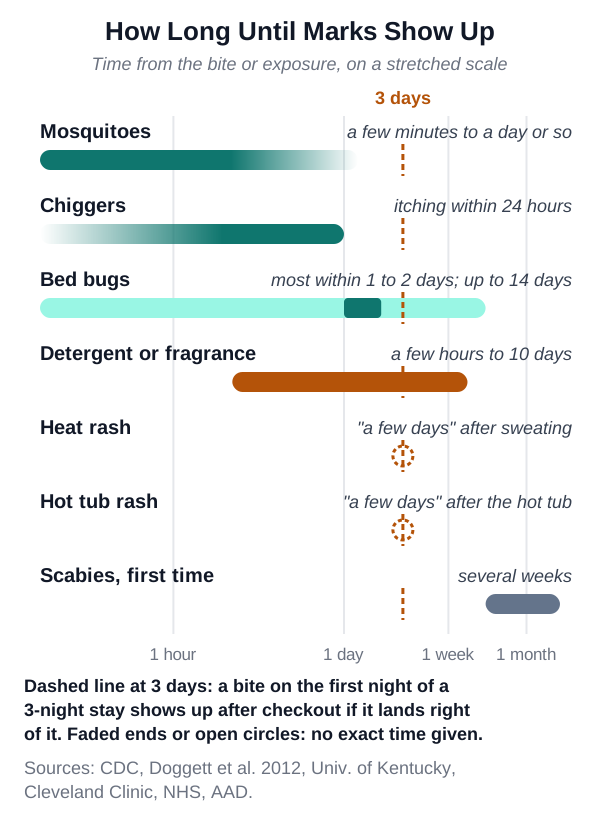
Airbnb's 72-hour reporting clock runs from discovery, not checkout, so a claim after checkout isn't automatically late. And the delay works in both directions. A mark a week after checkout can come from the stay (CDC). And a mark on night one can come from earlier in the trip, since most people show signs within 24 to 48 hours and the first bed bug someone sees "may not represent the initial encounter, especially while people are traveling" (Doggett et al., 2012).
Hosts in Facebook host groups have posted both: bed bugs claimed a week after checkout, and flea-like bites six days later. A host in Kissimmee, Florida, posted in August 2026 that guests reported bites "nearly a week later," and a licensed inspection found no evidence (Airbnb Community Center). Yet a guest who woke up to bed bugs in a London Airbnb wrote that month that "it took a week for the bites to come up" (Airbnb Community Center).
So I still inspect before the next check-in, pull the turnover photos and cleaner's notes, and look for signs of a pet when bites look like fleas. Airbnb's refund policy doesn't cover issues caused by the reporting guest's own pet, but fleas outlast the guest who brought them: a Jacksonville Beach, Florida, host posted in July 2026 that a guest's unreported pet left fleas for the next guests (Airbnb Community Center).
Airbnb already refunded the guest: how I'd dispute it
The Facebook host groups have posts about this too. One came from long-time Superhosts who had cleaners' video of a spotless unit and a full-day re-inspection that found nothing. Airbnb still refunded a guest's cockroach claim from her photos without their agreement, and their appeal failed.
Under the policy, a refund like that comes out of the host's payout, and Airbnb sizes refunds partly on "the strength of evidence provided" (Airbnb Rebooking and Refund Policy). To dispute it, contact Airbnb, as the policy says. The Ground rules, which list "refunding a guest from a host's payout" among actions Airbnb may take for a violation, let hosts appeal decisions under that policy by contacting Airbnb directly or through the link it provides.
What I'd attach:
- The written pest report.
- Dated turnover photos or video.
- The message thread.
- Any pest-control contract or service records.
Outcomes vary. A London host posted in August 2026 that Airbnb would restore a zeroed payout after the host escalated to a senior case manager and sent an engineer's report and a timeline, though that was a gas-smell refund, not pests (Airbnb Community Center). In Cyprus, guests cited "seeing an insect" and hygiene concerns. Their host posted that month that Airbnb decided to refund her the money it had paid them, after she sent her appeal twice and asked for escalation (Airbnb Community Center).
The review: extortion is grounds for removal, inaccuracy usually isn't
A clean inspection report alone usually won't remove a review. Reviews come down only "in limited circumstances," and Airbnb "generally" doesn't "mediate disputes concerning review accuracy" (Airbnb Reviews Policy). The Kissimmee host with the week-later bite claim had a signed inspection report and was still turned down twice.
Airbnb acts when a review breaks a rule. Its Reviews Policy has a section on reviews "involving bias, deception, extortion, incentivization, or pressure." It says: "Hosts and guests may not threaten a negative review as a means to obtain unwarranted compensation, refund, or other incentive." Reviews also may not be "provided or withheld in exchange for something of value," which binds hosts too. When a host on AirHostsForum floated that trade in July 2026, he posted that Airbnb support's answer was that he "cannot request no posting of review in exchange for refund" (AirHostsForum).
So when a guest ties the review to money, that message is your evidence. In one of the Facebook posts, a six-year Superhost facing a bed bug claim made a week after checkout says the guest wrote they wouldn't have reviewed badly if paid. I'd quote that message and, as a Community Champion advised in September 2025, "directly cite the exact Airbnb policy rule the review violates" (Airbnb Community Center). The Superhost had that message and still lost two removal requests, so it's no guarantee.
You can request removal "at any time," Airbnb usually decides "within 48 hours," and you can submit "up to two times" per review (Airbnb Help Center). Leave out medical details, since Airbnb won't consider health data. Our reading on "review removal services": they have no channel of their own. Only the listing owner, a full access co-host or a member of the hosting team can dispute a review, through this same request, and no Airbnb review page we checked mentions such services.
If the review stays, reply publicly: the response posts immediately next to the review (Airbnb, responding to a review) and can't disclose another person's private information (Airbnb Content Policy). For example: "A licensed pest professional inspected the room on [date] and found no evidence of bed bugs."
Scam or real? The signs I weigh
Hosts report patterns: a claim tied to money or a review, and no photos of the insect or bedding. I also look harder when a guest calls the unit unsafe but stays even after I offer a refund for unused nights. None of these is proof on its own. A guest who stays may simply have nowhere else to go that late, and missing photos are weak evidence too, since travelers "may be unable to produce a specimen" (UC IPM).
Real infestations leave physical signs: live bugs, shed skins, eggs, and rusty stains or dark excrement spots, often around mattress seams, though the EPA says low-level infestations are "much more challenging to find" (EPA). New mattresses and protectors don't rule them out: encasements "will not keep bed bugs from crawling onto a bed and biting a sleeping person" (University of Kentucky). They hit experienced hosts too: an eight-year host in Pinetop-Lakeside, Arizona, posted in July 2026 about confirmed bed bugs and a recheck after spraying that "found one" (Airbnb Community Center).
In a New Jersey study, 49% of infestations were in apartments whose residents didn't know (Wang et al., 2016), and the CDC says cleanliness "does not determine whether bed bugs are present" (CDC). We found no published figure for how often bite claims are false.
If the inspector does find bed bugs
I take the unit offline and block the dates on every site it's listed on, which is where channel manager or iCal sync speed matters. I cancel affected stays myself and contact Airbnb. Its valid host cancellation reasons "include, but aren't limited to" major damage and emergency repairs, so pests aren't named and a penalty-free cancellation isn't guaranteed. Within 24 hours of check-in, you have to contact Airbnb to cancel (Airbnb host cancellations).
Treatment "can take weeks to months" (EPA) and usually needs "multiple visits" (EPA). Heat can often clear an infestation in one day but leaves no residual protection (University of Kentucky). Insecticides can leave residual control (NPMA), but many "will not kill eggs, so treatment must be repeated" (EPA). Re-inspect "for at least two to three months" (Safer Pest Control Project, via Purdue Extension), and Airbnb may require proof the issue is fixed before you host again (Airbnb Ground rules).
On Vrbo or Booking.com
Vrbo's VrboCare terms say material defects "should be disclosed to Vrbo within 24 hours" and reported "promptly" (VrboCare terms, archived). Under Host Terms 9.9, Vrbo may refund a guest, and the host agrees to "reimburse Vrbo for any such refunds and for all costs and expenses" (Vrbo Host Terms, archived). Vrbo bars guests from threatening a review "to obtain refunds or additional compensation" (Vrbo Help).
Booking.com lists a guest "using the review to blackmail you" as a removal reason but needs "written evidence" (Booking.com Partner Hub). Its customer terms don't mention pests or set a refund rule for them (Booking.com terms).
What I set up before anyone complains
- Encasements made for bed bugs, checked regularly for holes and replaced when damaged (NPMA, EPA). I check mine for tears at every turnover.
- A seam check at every turnover, with dated photos of every bed.
- Periodic professional inspections, since properties "should not rely solely on tenant complaints" (University of Kentucky).
- Fragrance-free detergent: my choice, based on the detergent sources above, not a medical claim.
- Where a unit has a hot tub, water tested on a set routine. The CDC recommends chlorine of at least 3 ppm (or bromine at 4 to 8 ppm) and pH of 7.0 to 7.8 (CDC).
- A pet rule I enforce.
Four habits, and one thing to set up this week
Reply calmly and fast, and don't diagnose or apologize for bugs nobody has found. Get a proper inspection and a written report. Keep the record on Airbnb, and dispute a refund or ask for a review's removal only on Airbnb's own grounds.
This week, start one routine: a dated photo of every bed at turnover, with the encasement checked for tears. When a claim comes, those photos show what the bed looked like before the guest arrived.
Common questions
Does Airbnb refund guests for bed bugs?
Airbnb's Rebooking and Refund Policy doesn't name bed bugs, but by our reading a pest problem can count as a Reservation Issue if it makes the home not habitable at check-in. Guests must report within 72 hours after discovery, though Airbnb may allow late reports if the guest shows reporting on time wasn't feasible. If Airbnb determines a Reservation Issue occurred, it can refund the guest fully or partly, and the host's payout is reduced by the amount refunded.
Does Airbnb have a cockroach policy?
None of the Airbnb policy pages we checked names cockroaches. Airbnb's Ground rules say listings should be free of health hazards, with pests given as an example. By our reading, a cockroach report can count as a Reservation Issue under the Rebooking and Refund Policy, like other pest problems.
Do cockroaches bite people?
Rarely. NPMA says German cockroaches are not known to bite humans and American cockroaches rarely do, and the trade magazine PCT calls cockroach bites very rare in the United States, though more likely in a severe infestation. A cockroach claim is mostly about the insect and the unit: which species, how many and where.
Can I get a bed bug review removed if the inspection found nothing?
Usually not on that basis alone. Airbnb's Reviews Policy says Airbnb generally doesn't mediate disputes about review accuracy. A review can come down if it breaks a rule, such as a guest threatening a negative review to get an unwarranted refund or compensation. Airbnb allows up to two removal requests per review.
Does AirCover pay for bed bug treatment?
Don't count on it. By our reading, Airbnb's Host Damage Protection terms (last updated August 1, 2026) don't list pest treatment as an eligible loss. They also exclude damage caused by insects, animals or vermin, except damage caused by pets. Check the current terms for your country.
Sources
Read next
Guest Experience
How to handle a guest noise complaint before neighbors call the city
Cina ·
Tools & Software
Airbnb's new host tools for fall 2026: what to turn on first
Cina ·
Tools & Software
Channel manager vs. iCal sync: when the switch pays off
Cina ·


