Design & Furnishing
Mattress protector vs. encasement: what actually helps against bed bugs
A fitted mattress protector is a spill layer. Here's what a bed bug encasement does and doesn't do, and the check I run at every turnover.

On this page
- Mattress protector, encasement, pad: what you're actually buying
- What a mattress encasement does against bed bugs, and what it doesn't
- If you can only encase one thing, cover the box spring
- How to read an encasement label before you buy
- Layering a short-term rental bed: encasement under, washable protector on top
- My turnover check on an encased bed, without unzipping it
- What an encasement won't do when a guest makes a claim
- Sofa beds, cribs and pillows
- The setup, and one thing to do this week

A fitted mattress protector is a spill and stain layer, and none of the bed bug guidance we read recommends one. That guidance mostly asks for a full, zippered encasement made for bed bugs, and even that does less than the box suggests. It doesn't keep bugs out of the room or off the bed.
I've spent five years as a host and co-host and now manage 60 short-term rental units. This piece covers the bed you set up before anything happens; for the other side, see what I do when a guest says they were bitten. ("We" means RentalWe's editors, who read these sources in October 2026.)
Key Takeaways
- A fitted protector covers five sides and is for spills and stains; no bed bug guidance we read recommends one.
- A bed bug encasement traps any bugs inside and makes bugs on it easier to spot, but it won't stop bugs living elsewhere from biting. No study we found tests whether it keeps a clean bed from becoming infested.
- If you can encase only one piece, the sources we read point to the box spring, mostly in advice for a bed that already has bugs; Penn State's prevention list also puts box springs ahead of mattresses.
- My setup: encasement on and zipped, a washable protector on top, and a turnover check of the zipper end-stop, seams, frame and headboard.
Mattress protector, encasement, pad: what you're actually buying
The Better Sleep Council, the mattress industry's consumer arm, says protectors "typically have five sides and fit over the mattress like a fitted sheet". An encasement generally has six and "fully encloses either the mattress or box spring, usually with a zipper". Pads and toppers can add a comfort layer on top.
Names blur this: full zippered encasements are sold as "bed bug mattress protectors", and Texas A&M told shoppers to search that phrase to find encasements. Alaska's environmental agency says most covers and encasements on sale "will not work against bed bugs", and even some advertised as "bed bug proof" "might not be correctly designed".
The government and university guidance we read mostly asks for full, zippered encasements made for bed bugs. The National Pest Management Association (NPMA), in its best practices for pest professionals, calls encasements "limited in scope" and says only those "specifically designed for bed bug management should be used". At least four agencies also accepted covers sold for allergies or dust mites. NYC (2008), Michigan (2009) and Health Canada (page last updated 2015) wrote for a bed that already had bugs, and Health Canada points to "allergy or pest control supply companies". The FTC's 2011 tip was about keeping bugs out.
What a mattress encasement does against bed bugs, and what it doesn't
The EPA lists encasing mattresses and box springs among precautions that "can help prevent" an infestation: it eliminates "many hiding spots", and "The light color of the encasement makes bed bugs easier to see". Once it's sealed, bugs already inside "cannot escape or feed", says Alaska's agency.
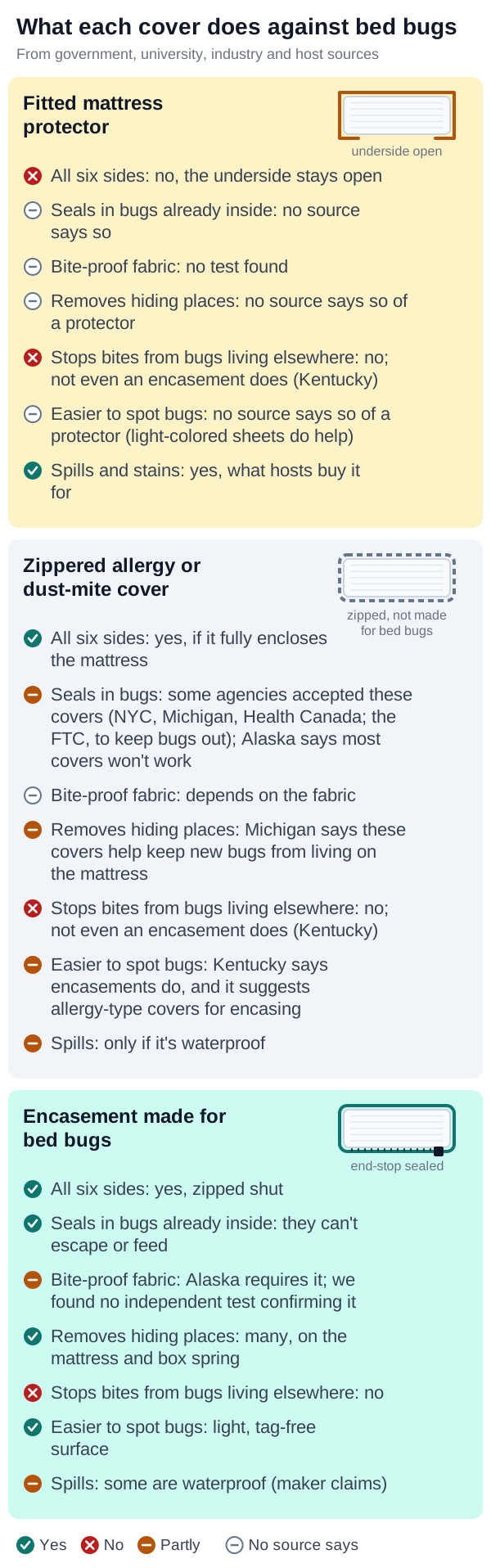
But Australia's pest industry code opens its chapter on reducing bed bug risk with "For practical reasons it is not possible to prevent bed bugs from entering a premise". A Virginia Tech entomologist's prevention sheet goes further: in its advice for a home with confirmed bugs, encasements "will not prevent or control bed bugs", though they save the bed and stop bugs hiding in it "from escaping and biting you".
The University of Kentucky adds that "encasements will not keep bed bugs from crawling onto a bed and biting a sleeping person". Bugs can live on the outside, too; Kentucky says encasements "make it easier to spot and destroy any bugs residing on the outer surface".
The evidence is thin: we found no study that tests whether an encasement keeps a clean bed from becoming infested. The one field test we found that varied encasements, a 2022 Rutgers PhD dissertation (not peer reviewed), ran in 14 New Jersey apartments that already had bed bugs. After the same pest-control program, the drop in bug numbers wasn't significantly different with or without encasements, and the author calls it "a preliminary investigation". A 2012 medical review adds that "many of" its lodging recommendations rest on the pest's biology "rather than the scientific evaluation of such procedures".
An encasement earns its place on a clean bed: University of Minnesota Extension calls encasements useful "when you want to protect a mattress you know is free of bed bugs", such as a new one. The University of California's pest management program (UC IPM) calls them "particularly useful for hotels or other facilities with many beds", though that line sits in its advice on managing bugs; its prevention section doesn't mention encasements. And if bugs do get in, an encasement can save the mattress: Kentucky calls encasements "an economical alternative to discarding infested beds", and the EPA says to leave encasements on a mattress with bugs in it for a year.
If you can only encase one thing, cover the box spring
A University of Kentucky entomologist says that if only one encasement is affordable, "it's often best to cover the box, which is harder to subsequently inspect". Virginia Tech and King County say the same. All three wrote about a bed that already has bugs, but Penn State Extension's prevention list also says to protect mattresses and, "more importantly", box springs. After treatment, UMN Extension recommends encasements on "all mattresses and box springs". A box spring needs its own encasement, sized for it.
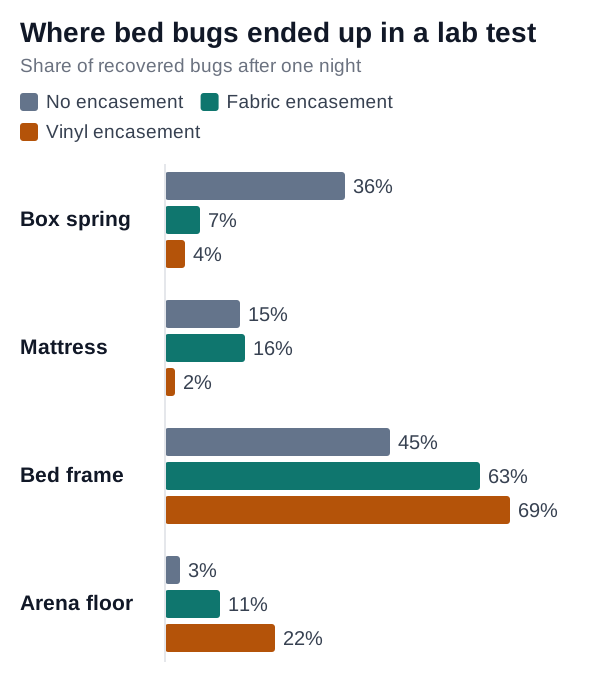
In a Rutgers lab test with miniature beds, encasements cut the share of bugs on the box spring and raised the share on the bed frame. The researchers write in Pest Control Technology that in "areas where encasements are deployed in a bed bug IPM program" (integrated pest management), "technicians would need to pay more attention to bed frames, linens and other items on the beds". That's a lab result; the study's field half had too little data to show where on the bed the bugs went.
Kentucky adds that "In hotels, the area behind the headboard is often the first place bed bugs become established", so the frame and headboard stay in my check. The expert guidance we read says nothing about encasing platform beds.
How to read an encasement label before you buy
To work against bed bugs, Alaska's environmental agency says, an encasement needs:
- Bite-proof fabric.
- Full coverage of the mattress or box spring.
- A tight seal with no openings, gaps or tears.
- Very small zipper teeth set close together.
- A zipper that seals completely at the end-stop.
A Virginia Tech entomologist calls a cover not zipped all the way up "the number one escape route used by bed bugs" (expert opinion, not data). Texas A&M suggests checking for "no visible gaps between teeth" and a pull that "hooks, or can otherwise be secured so that it will not open over time".
In a maker-funded UC Berkeley trial, fully zipped encasements held every test bug. The controls had zippers left open about 2 to 3 feet, and "By week 4, all five untreated control units had at least one escaped bed bug" (Pest Control Technology). It tested escape only, with adults and late-stage nymphs. We found no independent test of bugs getting into a closed encasement; the only maker "entry-proof" claim we traced rests on tests that sealed bugs inside and checked whether they got out or fed through.
"Tested", "lab-certified" and "bed bug certified" don't point to any public standard we could find: no ASTM, ISO or EPA bed bug test or certification for encasements. The bite and escape tests we found were funded or commissioned by makers, or cited by one without naming who paid. Bite-through depends on the fabric. In preliminary tests reported in a peer-reviewed 2013 paper funded by a liner maker, every bug of one lab strain fed through untreated liner fabric within 30 minutes. On plastic, Rutgers warns that "vinyl encasements easily rip or tear".
The EPA lists a cover "pre-treated with pesticide" as one option, but Alaska's agency says treated covers "do not effectively kill bed bugs or eliminate infestations" while exposing sleepers to insecticides. A 2022 lab study of 24 strains found pyrethroid-treated liners "not likely to be effective" against most modern infestations, and Australia's code doesn't recommend permethrin-treated covers either, citing that same study, which its editor co-authored. For a bed guests sleep on, I'd rather use an untreated encasement.
Read the warranty before you buy for a rental; the ones we read differ. One protector warranty excludes "rental purposes" and "drying on high heat", another cuts "commercial purchases (non-household purchases)" of some of its fitted protectors from 10 years to 2, and a hospitality-focused maker "makes no warranty against the infestation of bed bugs". If you're furnishing a new unit, see what to buy and what to skip in the first ninety days.
Layering a short-term rental bed: encasement under, washable protector on top
Putting a washable protector over the encasement is a host habit, and it's how I set up a bed. None of the expert guidance we read asks for it on a clean bed. A host in Australia who holds the forum's Community Champion badge described hers in December 2024: "The beds have a mattress encasement (bed bugs), then a waterproof mattress protector, then either a cotton mattress protector or topper" (Airbnb Community Center).
Australia's pest industry code says sanitation "can be improved" by a washable cover over the encasement. It says that about a bed whose encasement is containing bugs, though, so it doesn't speak to a fitted protector on a clean bed. The encasement stays sealed while the top layer takes spills and stains, the main reason several hosts in the forums give for a protector. The cost, as I see it, is that the top layer hides the encasement's light surface, so my check looks under it.
For the top layer and sheets, if you want the dryer to kill bugs, the EPA says high heat for 30 minutes, since "just washing will generally not kill bed bugs". Don't count on "tumble dry low": no study we could read has tested a low setting. Care labels pull the other way: most we read call for low, medium or "moderate" heat, or air-drying. A 2012 EPA module still on epa.gov has a dryer test: run dry towels on "hot and regular cycle (not fluff or press)" for 20 minutes. Then put a meat thermometer under a layer of towels and wait 2 minutes; it needs to reach 125°F.
UC IPM tells managers of hotels and furnished apartments that frequently laundering bedding during tenant turnover "can help prevent the spread and establishment of bed bugs". Australia's code says to bag used linen in the room. Laundering the top layer every stay is part of your turnover cost; the cleaning fee calculator shows what a cleaning fee that covers it adds to each night of a stay.
The encasement itself stays out of turnover laundry. Alaska's agency says "Once the encasement is installed, it should not be removed". Australia's code says encasements "should not be removed if being used for bed bug containment". On a clean mattress, it treats the encasement as a risk-management layer, and its chapter on reducing bed bug risk suggests one that's easy to take off for regular washing. If an infestation follows, the encasement can come off for a hot wash, as long as it goes straight back on. Alaska makes no such exception, and mine stays on at turnover, which fits both.
My turnover check on an encased bed, without unzipping it
My turnover check never opens the encasement. It covers:
- The zipper, closed all the way to the end-stop.
- The seams and surface: no tears, holes or worn spots.
- Dark spotting, shed skins or bugs on the encasement or the top layer.
- The box spring encasement, checked the same way.
- The frame, slats and headboard.
A light encasement shows dark bugs and spots. Eggs are harder: Kentucky says they're "hard to see without magnification, especially on light-colored materials".
Sources differ on how often, and some write for a bed being treated. Australia's code says lodging housekeeping should ideally inspect "when linen is changed" and record the date "even if no bugs are noticed". Penn State Extension's prevention list says to check mattress and box spring seams "when changing bedding". I do it at every turnover, and a dated photo of each bed is my record; it's what I pull out when a claim comes.
A full inspection is a bigger job: the University of Kentucky says a thorough one "requires dismantling the bed". If my check turns up spotting, skins or a bug, the room comes out of service. NPMA's hotel guidelines say to "Take the suspected room out of service until bed bugs have been eliminated or inspection reveals that the initial report was incorrect."
A torn encasement can become a hiding place: Michigan's manual says holes must be repaired to keep bugs from "gaining protection on the inside of the cover", and that "duct tape can be used to repair" a small hole in a vinyl encasement. Cornell says to "seal these completely with permanent tape or buy a new bag". My routine is to replace a torn one, which matches NPMA's "should be replaced as necessary"; no expert guidance we read sets a service life.
Interceptor traps under the bed legs help while someone sleeps in the bed. In a 2016 Rutgers study of 2,372 low-income New Jersey apartments, they detected 89% of infestations, against 72% for brief visual checks. But a 2011 study led by the co-inventor of their design says they "are not designed to monitor rooms that are vacant". It adds that "one should never assume zero catch implies the room being monitored is bed bug free".
What an encasement won't do when a guest makes a claim
An encasement won't settle a claim: none of the Airbnb or Vrbo pages we read, Airbnb's refund policy included, mentions encasements as evidence. In August 2024, a property manager whose profile lists Charlotte, North Carolina, posted that "all the pillows and mattresses have encasements" in the properties they manage. A guest's one-star bed bug review still stayed up: "Airbnb refuses to remove" it, as of the post (Airbnb Community Center). Guests do inspect the bed, too: an RV and rural host in Laton, California, posted in September 2025 that a guest "tore down the covers" (Airbnb Community Center).
Airbnb's Ground rules say listings should be "free of health hazards (mold, pests, etc.)", and its Host Damage Protection terms exclude "damage caused by insects, animals or vermin", except damage caused by pets. I'm quoting Airbnb's policy text here, and none of it is legal advice. For the response itself, see how I handle a bed bug claim.
Sofa beds, cribs and pillows
Sofa beds are a separate job. Texas A&M says living rooms with sofas and sofa beds are "the next most common sites for bed bugs", and Kentucky says bed bug-proof encasements for sofas and loveseats "can be supplied by pest managers". We found no expert guidance on encasing a sofa bed's fold-out mattress. For cribs, the federal Safe to Sleep campaign says a baby's sleep surface should be "covered only with a fitted sheet", and it doesn't mention encasements. Our advice is to follow the crib and mattress maker's instructions and keep the surface firm, with nothing loose.
Pillows are a judgment call. The EPA lists "pillow encasements", and Oregon's health authority recommended covering pillows in 2011, but we found no evidence on how well pillow encasements work.
The setup, and one thing to do this week
So my setup is an encasement made for bed bugs on the mattress and box spring, a washable protector on top, and a turnover check of the end-stop, seams, frame and headboard. None of it keeps bugs out or settles a claim. This week, check the zipper end-stop on every mattress and box spring encasement, and photograph it.
Common questions
Can bed bugs go through a mattress protector?
The Better Sleep Council says protectors typically have five sides, so the underside stays open, and none of the bed bug guidance we read shows one stopping bed bugs or recommends one for them. Even a full encasement doesn't keep bugs off the bed: the University of Kentucky says encasements "will not keep bed bugs from crawling onto a bed and biting a sleeping person".
Can bed bugs get through a mattress encasement?
We found no independent test of bed bugs getting into a closed encasement. In a maker-funded UC Berkeley trial reported in Pest Control Technology, fully zipped encasements held every test bug in, while ones left about 2 to 3 feet unzipped leaked. Biting through depends on the fabric, and Alaska's environmental agency says the fabric "must be bite-proof".
How long can bed bugs live in a mattress encasement?
No study we found has measured how long bed bugs survive sealed inside an encasement. The EPA says bed bugs "are capable of surviving several months to a year without feeding". The University of Kentucky says they last longer when it's cooler, and that "about 1 to 4 months" is more typical in temperature-controlled buildings. Every one-year leave-on rule we found is for a bed that already has bugs; none covers a clean bed.
Should you wash a mattress encasement?
I keep mine on at turnover and out of the laundry. We found no extension or government source that says to wash a new encasement before fitting it. Alaska's environmental agency says "Once the encasement is installed, it should not be removed." Australia's pest industry code says encasements "should not be removed if being used for bed bug containment". On a new or uninfested bed, it suggests an encasement that's easy to take off for regular washing. "If an infestation ensues", its membrane encasements "can be sanitised via hot wash and dry cycles" and go straight back on. If you wash one, follow its care label.
Do hotels use mattress encasements?
We found no current count of how many hotels use them. NPMA's bed bug guidelines for hotels say "Consider enclosing mattresses and box springs with bed bug proof encasements". Oregon's health authority wrote in 2011 that hotels "are often using them in all their rooms", an impression rather than a count.
Sources
Read next
Guest Experience
Guest claims bed bugs or bites at your Airbnb? Here's what I do
Cina ·
Tools & Software
Airbnb's new host tools for fall 2026: what to turn on first
Cina ·
Tools & Software
Channel manager vs. iCal sync: when the switch pays off
Cina ·


