Pricing & Revenue
Dynamic pricing tools and the market average: when to override them
Dynamic pricing tools are built around the market average. Events, your last unit, floors and last-minute policy are still your call, and the evidence and the math show why.

On this page
- Why do dynamic pricing tools land you near the market average?
- If everyone in your area uses the same kind of tool, who sets the price?
- What can't a pricing tool decide about events?
- How should you price your last unit near an event?
- Do experienced hosts ignore competitors?
- How to use a pricing tool without pricing like everyone else
- Your next step

In our own hosting, PriceLabs brought our prices up to the market average and helped us keep pace with other hosts. It didn't get us better-than-market prices. PriceLabs is the worked example here because it's the tool we used and it documents its engine step by step. Similar tools such as Beyond, Wheelhouse and Airbnb's Smart Pricing also start from the market around you.
That makes dynamic pricing tools a useful baseline, and probably worth it if you'd otherwise price flat. What they shouldn't decide for you is your event strategy, your last available unit, your minimum price or your last-minute policy. This article tests four claims from our hosting across the category, including where the evidence disagrees with us.
None of this argues against dynamic pricing, and the 2026 occupancy and rate benchmarks make the case for running it actively. The trouble starts when you accept any tool's defaults as your own prices.
Key Takeaways
- Dynamic pricing tools start from what comparable listings charge and judge you by market pace.
- For hosts who price flat, market-level pricing earns more. A 2021 study found that Airbnb Smart Pricing adopters saw nightly rates fall 5.7% while daily revenue rose 8.6%.
- One host can't set a whole area's base by raising first. Prices move together through shared inputs, such as PriceLabs' event factors and its competitor-matched last-minute default.
- Hold your last unit near an event only while the chance of a late, high-paying guest is at least today's price divided by the price you're holding out for.
- Ignore competitors' prices as an anchor, but watch their supply. In Kansas City during the 2026 World Cup, available nights grew 48% against 20% more demand, and occupancy fell 19%.
Why do dynamic pricing tools land you near the market average?
Dynamic pricing tools build your price on two market references: what comparable listings charge, and how fast the market books. PriceLabs documents both step by step. Its help center defines your base price as the "average nightly rate you'd charge across the whole year". Its Market-Driven model, "the best starting point for most users", begins with "the average price of comparable nearby listings including their cleaning fees" (PriceLabs Help Center).
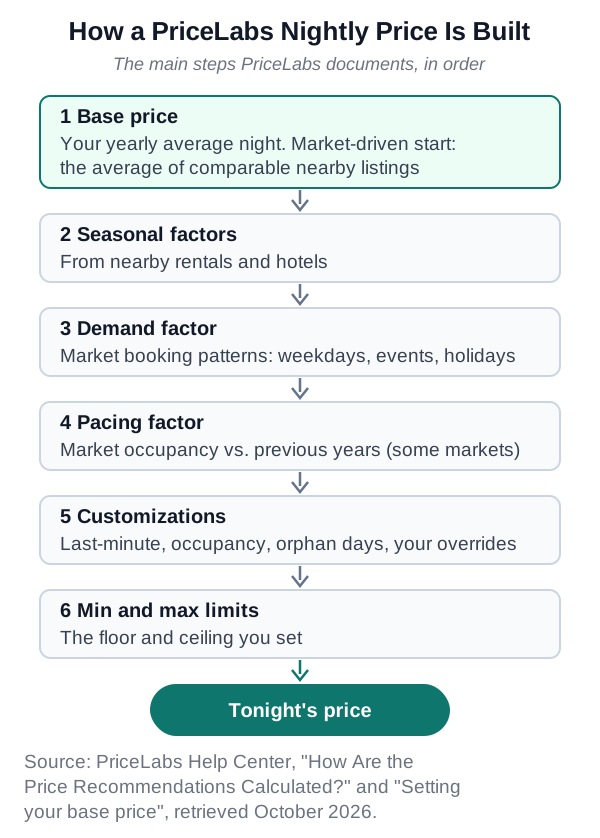
Each nightly price then passes through market-wide layers. Seasonal factors are "derived from historical data of rentals and hotels in the surrounding area." A demand factor analyzes "booking patterns in the market" and, in some markets, a pacing factor kicks in when your market's occupancy runs well ahead of or behind previous years. PriceLabs then applies your own customizations, overrides and minimum and maximum prices on top (PriceLabs Help Center).
The second reference is pace. PriceLabs suggests raising your base "if your place is booking faster than the market" (PriceLabs Help Center). Its default occupancy adjustments add "a premium" when your occupancy beats the market's, "otherwise a discount" (PriceLabs Help Center). The base recommendation updates weekly from a 60-day window, and its nudges "never auto-apply" (PriceLabs Help Center). In other words, the recommendations aim for booking as fast as the market does, which is what an average listing does.
The comparison group is built to be typical, too: PriceLabs says to aim for at least 30 listings, and it removes outliers automatically (PriceLabs Help Center). Its percentile guide calls the 50th percentile "Ideal for average-quality listings" and "safe and market-aligned", and suggests the 75th for "high-end listings or when demand is high" (PriceLabs Help Center). Standing out is left to you, as a PriceLabs blog post concedes: "To differentiate yourself from others, you can set a higher base price than aiming for a certain percentile" (PriceLabs blog).
To be fair, PriceLabs says its modeling reacts "to actual market demand" and warns that "competitors make pricing mistakes too, and if you simply match their rates, you end up copying those mistakes" (PriceLabs blog). That demand is still a shared market signal, read the same way for every listing nearby.
PriceLabs isn't unusual: Beyond's Base Price Helper draws on "historical and future scraped prices for listings in your market" (Beyond Support), and its Health Score treats a listing "booking on pace with the market" as "priced correctly based on supply and demand" (Beyond Support). Wheelhouse's base price is what it "would recommend charging for a night at your property, given average demand" (Wheelhouse Help Center), and Airbnb's Smart Pricing aims to keep a listing "automatically competitively priced for your area" (Airbnb Help Center). Names and details differ, so check how your own tool sets its starting price.
Where average is an upgrade
For a host who prices flat, average is an upgrade. A 2021 study in Marketing Science found that Airbnb hosts who adopted Smart Pricing saw their average nightly rate fall 5.7% while average daily revenue rose 8.6% (Zhang et al.; INFORMS). A 2018 study of 39,837 Airbnb listings and 1,025 hotels across five markets found that "hosts make limited use of dynamic pricing strategies, especially as compared to hotels" (Gibbs et al.). Airbnb's own dynamic pricing, which recommends a price range and starts rolling out in October 2026, is covered in what Airbnb's new host tools do.
Revenue rose while rates fell, so Airbnb's tool helped the typical adopter by filling more nights, and the study says nothing about hosts who already priced well. Judge any tool by the same yardstick, revenue per available night, rather than by occupancy.
If everyone in your area uses the same kind of tool, who sets the price?
On the arithmetic, the first host who raises doesn't set the area's price. We wondered whether, if a whole area runs PriceLabs or a similar tool, the first host to raise prices effectively becomes the base price for everyone else. The numbers say one host can't do it in one step: with the 30 or more comps PriceLabs suggests, a $100 raise by one of 31 listings moves the average $3.23. A sky-high price is also a candidate for PriceLabs' automatic outlier removal (PriceLabs Help Center).
Prices do move together, led by inputs every listing on the same tool shares. In PriceLabs, for example:
- Event factors: for known events, PriceLabs' Revenue Management team adds a "price factor" that "increases prices in a specific radius around the event location" (PriceLabs Help Center).
- Demand signals: the demand and pacing factors read the same market booking data for every listing nearby (PriceLabs Help Center).
- Last-minute rules: on Hyper Local Pulse, PriceLabs' newer algorithm, the default Market Driven (Balanced) setting "applies the same Last Minute adjustments seen on your competitors" (PriceLabs Help Center).
Economists have seen this pattern in other markets. In a study of German gas stations (working-paper figures), market-level margins in two-station markets "do not change when only one of the two stations adopts, but increase by 28% in markets where both do" (Assad et al.). Another paper shows that algorithms which ignore competitors' prices can still drift higher, because rival algorithms end up "running correlated experiments" (Hansen, Misra and Pai). Neither studied rental tools.
Nobody independent counts how often a whole area runs one tool. AirDNA estimates that 31% of US hosts use dynamic pricing (15% globally), a figure Skift reported in September 2026 as AirDNA launched its own pricing tool (Skift). Vendor surveys run higher: PriceLabs says "58% of hosts already use tech to run their pricing" (PriceLabs), and Hostaway reported 62% of hosts and managers, without disclosing its method (Hostaway). On any of these estimates, a one-tool area isn't the US norm.
A thought experiment: a market that only copies the average
To see what pure comp-anchoring would do, picture 31 listings with base prices scattered around $200. Every week, each one moves halfway toward the average of the other 30, with no guests, bookings or demand feedback. This is a consensus model from a 1974 statistics paper (DeGroot), run as a thought experiment. It isn't PriceLabs' algorithm or any vendor's.
If nobody resists, the spread shrinks to a cent within 10 weeks and everyone sits on the average. If one host holds $240, the others' average drifts to about $224 after a year and $233 after two. A holdout at $260 pulls them to about $235 and $250.
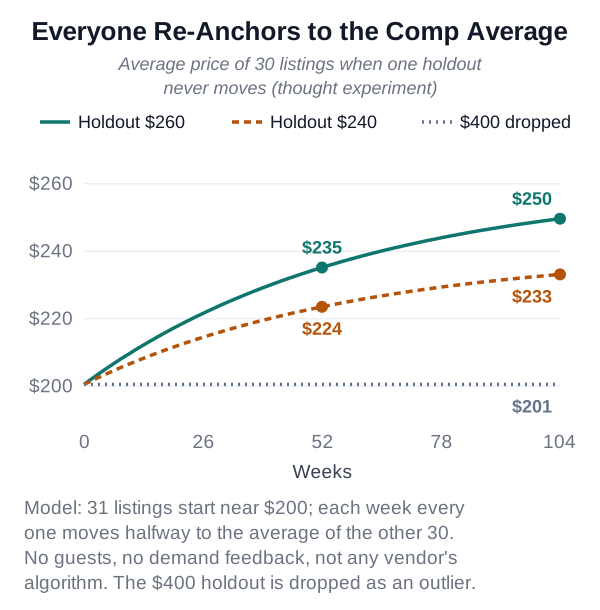
A $400 holdout goes nowhere if listings more than 50% from the median are dropped: the others stay at about $201 after two years. So our hunch holds in slow motion, but only for a moderate raise that one host keeps up for a year or more. Real tools also add demand feedback, such as pacing against last year and occupancy adjustments, which pulls prices back toward what guests actually pay.
What can't a pricing tool decide about events?
A pricing tool can't act on what only you know, such as a confirmed local event it hasn't flagged or your choice to lock a floor early. PriceLabs' algorithm monitors "booking patterns and occupancy trends in your area" and raises prices when demand surges unexpectedly. For known events, its Revenue Management team adds price factors that "decay" as the date nears (PriceLabs Help Center). Both are market-level moves that follow the data.
PriceLabs' own blog says algorithms "work from data" and adds: "What they can't access is your local knowledge." For any confirmed local event, it says you "should lock a minimum price floor before the algorithm has a chance to discount into that demand" (PriceLabs blog). PriceLabs claims in the same post that operators who override event dates "consistently capture" 30 to 50% more revenue on those nights than algorithm-only pricing, without publishing data behind the figure, so treat it as a vendor claim.
At the 2026 World Cup, higher prices did far more for hosts' revenue than extra bookings did. AirDNA, which sells data and its own pricing tool, found that short-term rentals in the 16 host cities earned $276.7 million more during the tournament (June 10 to July 19, 2026) than in 2025. Higher nightly rates produced $231.8 million of that, or 84%, and extra nights only $44.9 million, or 16% (AirDNA). In AirDNA's words, "For hosts, the World Cup was less a demand event than a pricing event."
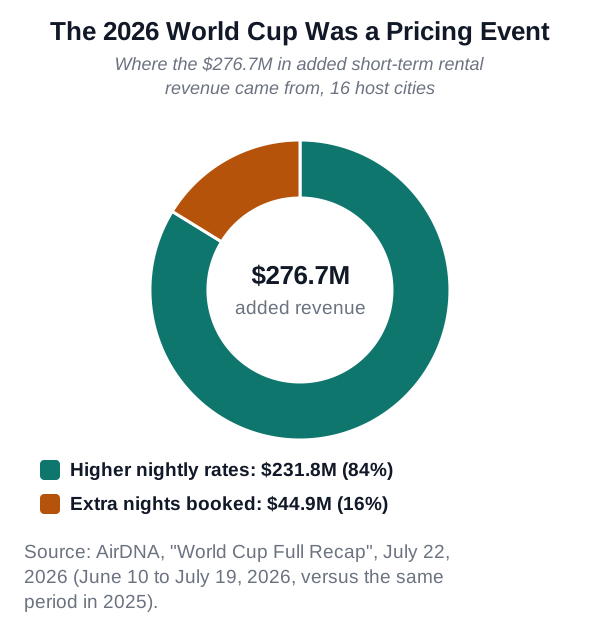
Supply decided how scarce rooms got: occupancy fell in 12 of the 16 markets "as supply outpaced the demand the tournament brought in." In Kansas City, demand nights rose 20% but available nights rose 48%, pushing occupancy down 19% (AirDNA). Kansas City public radio station KCUR reported that the city's short-term rental revenue still rose 88%, "but not because of an increase in demand" (KCUR).

Bookings followed certainty. Because group-stage matchups were set well ahead, fans booked early. For knockout games, with teams unknown until days before, fans were "more reluctant to commit" and "last-minute bookings weren't enough to make up the difference" (AirDNA).
So set event prices as soon as the event is confirmed instead of waiting for the algorithm to notice. Check the typical booking lead time in your market, and research the events and demand shifts near your address before you set the dates.
How should you price your last unit near an event?
Hold the last unit back only while the chance of a late, high-paying guest is at least today's price divided by the price you're holding out for. That's Littlewood's rule, first presented in 1972 for airline passenger bookings (Littlewood).
Our third claim was that a pricing tool doesn't hand you a strategy. With three units near an event, we'd price the first two at a reasonable margin, at or a little above comparable listings, and hold the last one for a much higher price, because the scarcer the area's rooms get, the more the last one is worth.
The numbers below are an illustration with assumed inputs rather than market data. You can book the unit today at $300, the market rate for the event night, or hold out for $700. Divide $300 by $700 and you get 42.9%, so hold only if you'd bet at least 43% that someone pays $700 before the date. The bigger the premium, the lower the bar:
- 1.5x today's price. Chance you need: 67%.
- 2x today's price. Chance you need: 50%.
- 2.5x today's price. Chance you need: 40%.
- 3x today's price. Chance you need: 33%.
Now apply it to three units. Assume a 60% chance of at least one late $700 guest, 20% of at least two and 5% of all three, so only the first held unit clears the 43% bar. Expected revenue agrees: selling all three now earns $900, holding one back earns $1,020, holding two earns $860 and holding all three earns $595.
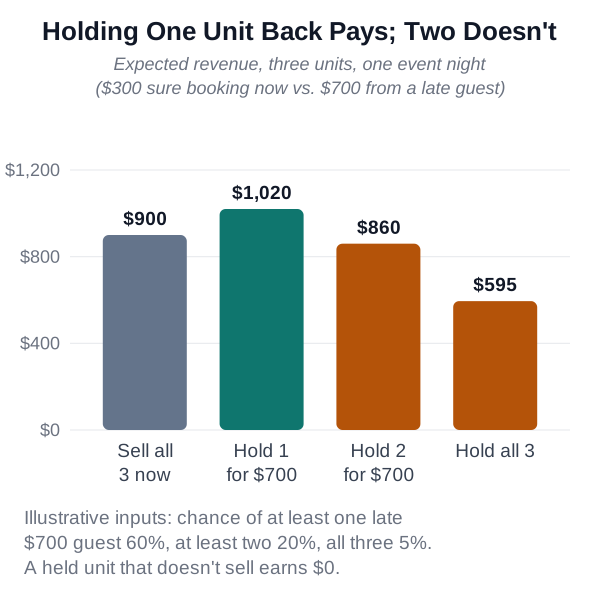
Under these inputs, our instinct is the best of the four options, and holding a second unit loses money against selling everything now. The figures assume a held unit that misses its $700 guest stays empty. With a fallback, say a 70% chance of a last-minute sale at $250, the bar for holding drops to about 24%.
How to estimate the chance honestly
The whole play hinges on that probability, and people tend to guess high. A study of more than 60,000 forecasts from four supply-chain companies found that upward adjustments "were much less likely to improve accuracy than negative adjustments" and went the wrong way more often. The authors read that as "a general bias towards optimism" (Fildes et al.). The study covered supply chains, not rentals. Before you hold a unit, check:
- Last year's booking pace for the same event, if it ran.
- How certain the event is: fixed dates and known lineups book early, while a matchup set days ahead may not fill late.
- How fast supply is growing near you, as Kansas City showed.
- What a realistic last-minute fallback would pay.
The tools give you levers, but the decision stays with you. PriceLabs' portfolio occupancy adjustments raise prices as a group fills. For 2 to 4 units, though, PriceLabs says "its impact may be limited because each booking significantly shifts occupancy levels" (PriceLabs Help Center), and default single-listing occupancy premiums are capped at 15% (PriceLabs Help Center). On its own, that's far short of the premiums in the table above.
Other tools have similar dials, such as Beyond's rate-focused strategy tier (Beyond Support) and Wheelhouse's Aggressive strategy (Wheelhouse Help Center), and none of them decides how high to hold one unit for one event.
Do experienced hosts ignore competitors?
Not entirely: ignore competitors' prices as an anchor, but don't ignore their supply. Our fourth claim was that hosts who've done this a long time set prices from events and from what the property is actually worth, and look at what drives guest demand rather than at competitors. Pricing from events and real value mostly holds up.
A University of Michigan working paper found that properties run by professional hosts "earn 16.9% more in daily revenue, have 15.5% higher occupancy rates" after controlling for property and market. It also found that nonprofessional hosts are less likely to vary rates around "major holidays and conventions" (Li, Moreno and Zhang). The 2018 study cited above found that hosts who "manage more listings and have more experience vary prices the most" (Gibbs et al.).
Short-term rentals also captured less of the scarcity premium than hotels. In CoStar data presented in 2019, the premium on compression nights (when hotel occupancy hits 95% or higher) was 15% for short-term rentals versus 39% for hotels in the top 25 markets (CoStar).
Ignoring competitors needs a correction. In Kansas City, more supply turned a rise in demand into a drop in occupancy, so watch how many listings open near you, even if you ignore what they charge. On BiggerPockets, host Laura Winters wrote that "any price tools are guidance". Former hotel revenue manager John Racine said he studies the numbers daily to "drive my rates above my competitors while maintaining strong occupancy" (BiggerPockets).
How to use a pricing tool without pricing like everyone else
Keep your tool for routine nights and take back the decisions it can't make. PriceLabs, for one, advises: "For routine demand fluctuations, trust the algorithm" (PriceLabs blog).
- Base price. In PriceLabs, for example: Suggests a Market-Driven start from comps. When to change it: When costs or real value differ from comps.
- Occupancy-versus-rate setting. In PriceLabs, for example: Demand Factor Sensitivity, default Recommended. When to change it: Toward Aggressive if you'll wait longer for bookings.
- Last-minute discounts. In PriceLabs, for example: Market Driven (Balanced) on Hyper Local Pulse copies competitors' adjustments. When to change it: When your pace shows discounts don't pay.
- Occupancy adjustments. In PriceLabs, for example: Market-Driven profile, premiums capped at 15%. When to change it: Portfolio mode at five or more units.
- Date overrides. In PriceLabs, for example: None set; the algorithm and PriceLabs' event factors apply. When to change it: Every event, as soon as it's confirmed.
- Minimum price. In PriceLabs, for example: Enforces the floor you set, after customizations. When to change it: Build it from your costs.
Other tools use different names for these settings, so check what yours calls them.
Build your minimum price from your own costs, then use the break-even occupancy calculator to see what share of nights you'd need to book at that rate to cover your fixed costs. RedAwning, a property management company, advises building the floor "from cost (cleaning, platform fees, owner split, minimum margin), not from competitors" (RedAwning).
Outside confirmed events, make few overrides, and make them count. PriceLabs' "10% rule" says to investigate the data before overriding whenever your instinct differs from the algorithm by more than 10%. It also warns that overrides made because you "feel like" rates should be higher, without checking pacing data, "usually hurt performance" (PriceLabs blog). The supply-chain forecasting study supports making them count: larger adjustments tended to help more, while "the smaller adjustments often damaged accuracy" (Fildes et al.).
Pair event prices with minimum-stay rules for event dates; that guide also covers PriceLabs' gap settings. Then run the last-unit check before each major event.
Your next step
Dynamic pricing tools are built around the market average, a real gain if you price flat. Your events, your last unit, your floor and your last-minute policy are the calls that set you apart. This week, compare your base price with your tool's market-driven suggestion, list next year's events with the dates you'll override, and run the last-unit check on the biggest one.
Common questions
Are dynamic pricing tools worth it?
Dynamic pricing tools are probably worth it if you price flat or rarely update rates. A 2021 Marketing Science study found that Airbnb hosts who adopted Airbnb's own Smart Pricing earned 8.6% more daily revenue. No independent study has measured what third-party tools such as PriceLabs, Beyond or Wheelhouse do to prices or revenue, so every revenue-lift figure for those tools comes from a vendor. On cost, PriceLabs bills per listing per month, with an alternative plan at 1% of booking revenue. Beating the market still depends on the calls these tools leave to you, such as event prices and your floor.
Does Airbnb's new dynamic pricing replace third-party tools?
It's too early to tell, and nothing in the announcement says it will set your event strategy. Airbnb's Resource Center said on September 30, 2026: "We'll recommend a price range that helps you earn more when demand is high, and stay booked when it's not." It added that "Dynamic pricing starts rolling out in October." Airbnb's announcement doesn't say whether the tool replaces Smart Pricing.
Is it collusion if everyone in my area uses the same pricing tool?
This is general awareness, not legal advice. In Gibson v. Cendyn Group (2025), the Ninth Circuit held that alleging competing hotels independently licensed the same price-recommendation software wasn't enough to state a Sherman Act claim. The court also said that agreeing among themselves to abide by its recommendations would "undoubtedly violate Section 1" of that law. RealPage makes software for apartment rents rather than short-term rentals. A settlement the Justice Department announced in November 2025 would require it to stop using competitors' nonpublic information to set prices. Ask a lawyer about your own situation.
Should I turn off automatic last-minute discounts?
Not automatically, but check your tool's default. On PriceLabs' Hyper Local Pulse algorithm, the default Market Driven (Balanced) setting copies the last-minute adjustments seen on your competitors. RedAwning, a property manager, warned for Q4 2026 that "buying occupancy with rate fails for everyone once the whole market does it." Late bookings still matter, since AirDNA found that about a quarter of World Cup group-stage bookings came within two weeks of the stay, so keep last-minute prices above a cost-based floor.
How often should I review my tool's settings?
Weekly works well. PriceLabs, for example, updates its recommended base price weekly and nudges you when your base drifts more than 7% from it. Andrew Steffens, a Florida vacation rental manager, wrote on BiggerPockets that "This is not a set it and forget it tool, you need to tweak it at least weekly."
Sources
Read next
Pricing & Revenue
Minimum stay settings: when to hold firm and when to bend
Cina ·
Pricing & Revenue
US short-term rental occupancy, ADR & RevPAR statistics (2026)
Cina ·
Tools & Software
Airbnb's new host tools for fall 2026: what to turn on first
Cina ·


