Update · United States
Maryland sets statewide safety rules for short-term rentals
The Maryland Short-Term Rental Safety Act took effect October 1, 2026. Equipment rules apply now. Platforms must collect inspection proof, but counties have until July 2028 to require inspections.
Since

As of October 1, 2026, Maryland short-term rentals offered for stays of less than 30 consecutive days, including houses, apartments, condos and co-ops, must meet a statewide fire-safety floor. Gov. Wes Moore approved the Jillian and Lindsay Wiener Short-Term Rental Safety Act on April 14, 2026, as Senate Bill 624, Chapter 10 of 2026 (Maryland General Assembly), and House Bill 1221, Chapter 9 (Maryland General Assembly).
What hosts must have now
In each unit, the host must:
- Post an evacuation diagram where guests can see it, showing every exit from the unit and, in a larger building, the building's exits.
- Post emergency phone numbers for police and fire rescue.
- Provide a working fire extinguisher.
- Provide working smoke alarms and carbon monoxide (CO) alarms, installed and maintained under state, county and municipal fire codes.
If a unit needs more than one smoke alarm, the alarms must be interconnected so one sets off all of them, or meet an alternative the State Fire Marshal authorizes. Smoke and CO alarms must both be "clearly audible in all sleeping rooms and sleeping areas," and loud enough to hear over background noise with the bedroom doors closed. Replace any smoke or CO alarm that stops working, is more than 10 years old based on the "production date" on its back, or has no production date.
The act adopts Maryland's existing CO alarm definition (Maryland Code). A lab-listed alarm "wired into an alternating current (AC) powerline with secondary battery backup" qualifies. Sealed alarms with a "long-life battery" of at least 10 years, and remotely monitored ones, qualify only "for a hotel, a lodging or rooming house, or a rental dwelling unit," and the act doesn't say whether a short-term rental is one. The definition doesn't mention plug-in alarms, and standalone replaceable-battery alarms fit none of its options.
The act adds no penalty, though its fiscal note assumes "existing criminal penalty provisions" apply.
What booking platforms must do
The act covers any "booking service": a platform that takes offers, reservations or payment for short-term rentals and charges a fee, such as Airbnb or Vrbo. Sites that only list or advertise are excluded. A booking service must electronically notify its hosts of these rules and require each host to provide "confirmation documentation" for each unit.
That documentation is the certificate, receipt or other proof an inspector gives you after your unit passes a county inspection. Until your county inspects, you may have nothing to send. As of October 12, 2026, Airbnb's help page on home safety doesn't mention the law (Airbnb Help Center).
What waits until 2028
By July 1, 2028, each county and Baltimore City must require annual inspections of all short-term rental units and report to the State Fire Marshal. The requirement doesn't apply where a county bans short-term rentals. Counties may charge a fee to cover inspection costs.
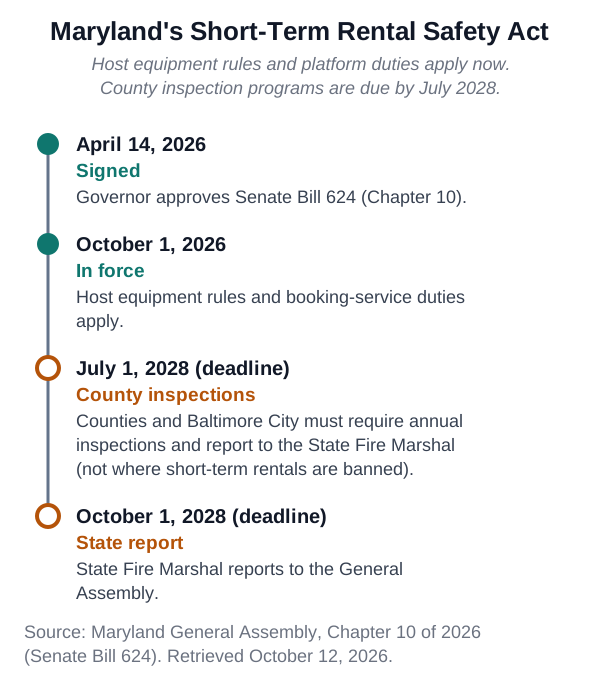
Counties can still add rules of their own (Chapter 10), so the state list is a minimum. The address-by-address checks in the short-term rental permit guide still apply.
What to do now
- Walk through each unit with the list above and our first-90-days buying guide, and check the production date on the back of every smoke and CO alarm.
- If the unit needs several smoke alarms, confirm they're interconnected or ask the State Fire Marshal's office about an approved alternative.
- Replace standalone replaceable-battery CO alarms. Ask the State Fire Marshal's office whether a plug-in or sealed-battery alarm qualifies.
- Ask your county whether it already inspects short-term rentals, and keep any certificate for your booking platforms.