Taxes & Accounting
Airbnb occupancy tax: what Airbnb collects and what you may still owe
A tax line on the guest's receipt doesn't mean every tax is handled. Here's what Airbnb, Vrbo and Booking.com collect, what may still be yours, and what I'd ask the tax office.

On this page
- What short-term rental occupancy tax is, and what it's called where you live
- Does Airbnb collect occupancy tax for you?
- Vrbo, Booking.com and direct bookings
- What you may still owe when a platform collects
- What gets taxed: cleaning fees, deposits and long stays
- How I'd find my own tax office, and what I'd ask
- What I'd keep as proof, and what to do if you're behind
- Three Airbnb occupancy tax steps before the first booking

A first booking comes in, and taxes show up as their own line on what the guest paid. It's tempting to assume the platform has the tax covered. Sometimes it has covered only part of it.
Airbnb occupancy tax is usually charged to the guest, but if nobody collects it, the host can still owe it. Where a platform is required by law, or has agreed with the government, to collect and remit a tax, the platform sends that tax in. Everything else (other layers, other channels, any registration or returns) is usually the host's job, and Airbnb's Terms put "determining and fulfilling your obligations" on you.
This is general information for US hosts, not tax or legal advice for your address. RentalWe's editors, the "we" in this article, read every cited page on October 19, 2026.
Key Takeaways
- A short-term rental occupancy tax is charged on the stay and is usually passed on to the guest. Making sure all of it gets collected and filed tends to fall to the host.
- Airbnb, Vrbo and Booking.com each collect some taxes in some places, and only on their own bookings. Direct bookings are usually yours.
- Where a platform collects everything, some tax offices still want you registered and filing returns, even at $0. Others don't.
- If I were setting up a first listing, I'd check what each channel says it collects, email my tax office five questions and keep a monthly record.
What short-term rental occupancy tax is, and what it's called where you live
Occupancy tax is a tax on a short stay. It's usually added to the guest's price and sent to state or local governments.
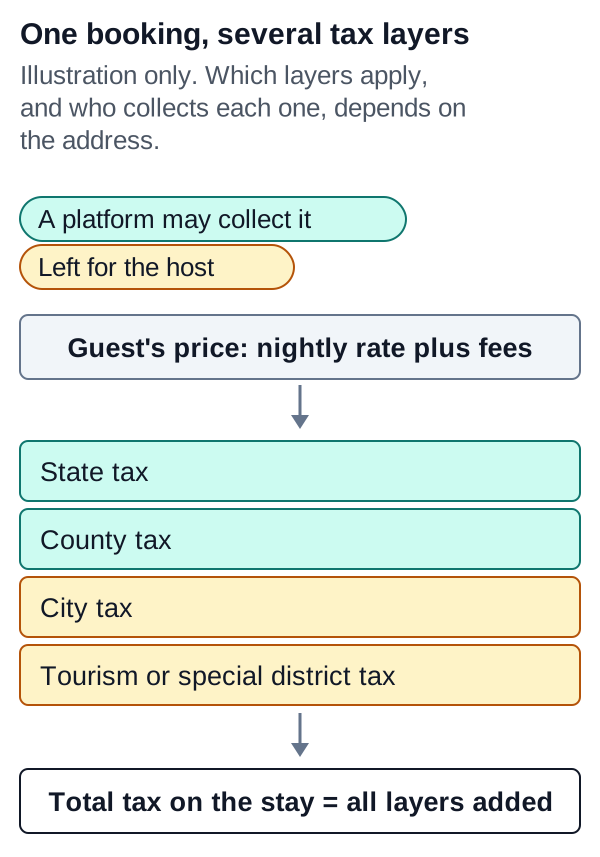
Vrbo's lodging tax overview says lodging tax may also be called "stay tax, occupancy tax, room tax, sales tax, tourist tax, or hotel tax," and that requirements "vary by city, county, region, state, and country." Official tax pages also use names like transient occupancy tax (TOT), accommodations tax, lodgers' tax, hotel-motel tax and tourist development tax.
One stay can owe several layers: state, county, city, and sometimes a tourism or special district tax. Added together, they make the combined rate, though some layers are a flat amount per night or per guest instead of a percentage. A platform may collect some of those layers and not others.
Occupancy tax isn't income tax, either. Rental income is a separate matter for your federal income tax return. IRS Topic 415 and Publication 527 explain how it's reported. Airbnb's US tax documents page adds that "Occupancy taxes collected and remitted by Airbnb are not considered in your Gross Amount" for the 1099-K, while pass-through taxes, the ones Airbnb collects and passes to you to file, are included.
Does Airbnb collect occupancy tax for you?
In some places, for some taxes. Airbnb's tax collection page says it "automatically collects and remits certain taxes on behalf of hosts," and that hosts "may need to manually collect and remit other applicable taxes." Its own example: "Airbnb may collect regional taxes but not local ones in some places."
Where Airbnb has agreements with governments or is required by law, it "calculates these taxes and collects them from guests at the time of booking," then sends them in, per its list of areas where it collects. The list is by state, but some of the pages underneath cover only certain counties or cities. The same page adds: "Hosts located in these areas are responsible for assessing all other tax obligations, including state and city jurisdictions."
Airbnb picks taxes from your listing's address, and its tax collection page says it "is not responsible for any tax collection errors due to typos."
Checking your listing
On desktop, click Listings and pick the listing. In the Listing editor, click Settings, then Taxes under Edit preferences. Airbnb's tax collection help says: "If there isn't a section for local tax collection under Taxes, we don’t automatically collect and pay on your behalf for that listing."
Collected taxes appear in "the gross earnings section of the transaction history," per Airbnb's tax collection help. Airbnb adds a caveat: "Not all taxes are shown in this section, because some features are still being updated." Guest receipts also list taxes as "a separate line item."
That tax line can bundle more than one tax. In a November 2023 Community Center thread, one answerer with the forum's Champion badge said that on their reservations every tax showed up under a single "Occupancy Taxes" line.
The tax sits on top of your price. Airbnb's tax collection help says: "Whether or not Airbnb automatically collects taxes, it doesn’t change the total payout you receive as a host."
Exemptions and Airbnb's Terms
If you think a tax Airbnb collects doesn't apply to you, Airbnb treats accepting the booking as waiving that exemption. The areas page is direct: "If a host does not want to waive an exemption the host believes exists, the host should not accept the reservation."
Airbnb's Terms also let it seek more money, including from future payouts, when the taxes it collected fall short, and stop collecting anywhere "for any reason" with prior notice.
Adding a missing tax
Where a tax isn't collected, Airbnb's custom tax tool may let you add it. Airbnb says the tool is "now available to most hosts," but the tax types it offers "may not cover your needs." You can charge a percentage per booking or a fee per guest, per night or both. Only the percentage option lets you choose whether it applies to the nightly price, fees or other charges. Its collecting taxes page says the feature "isn’t available in all regions or cities."
To use it, you attest "that the tax amount provided is correct," per the collecting taxes page. The tax then comes to you "as a separate pass through tax payout," and filing and paying it stays with you, per Airbnb's Taxes for hosts page.
If you collect it another way, Airbnb's manual tax collection page says "it's important that you inform guests of the exact tax amount prior to booking."
Vrbo, Booking.com and direct bookings
Each platform collects only on its own bookings, in its own list of places. Anything else is usually yours.
Vrbo
Vrbo's help on viewing lodging taxes says the Taxes page in its Owner Dashboard shows "the taxes that Vrbo is required to collect from travelers and remit directly to your jurisdiction," plus a section for "taxes for which you're liable" that "appears only in select jurisdictions."
Vrbo is firm on its side: "You can’t opt out of our collection and remittance of lodging tax in jurisdictions where we are required by law to collect and remit or where we have an agreement with the tax authority." Its collection and remittance page adds: "You're also responsible for collecting and remitting lodging taxes when we're not liable to do so."
If a guest booked before Vrbo started collecting in your area but checks in after, Vrbo's tax page for guests says "you remain responsible for collecting and remitting tax for that booking."
Vrbo's tax options page says that in eligible places you can have taxes collected and sent to you to file, or hand filing to a paid third-party service.
Connected software can matter too. Vrbo's collection and remittance page tells hosts to check with their local authorities when "You used an external software to integrate with our online system." Airbnb's collecting taxes page says its custom tax feature "may not be accessible through your API-connected software." If I ran several channels through one tool, I'd check how it handles tax (see channel manager vs. iCal sync).
Booking.com
Booking.com's partner help says: "In some U.S. jurisdictions, we're responsible for calculating and remitting taxes." That covers only reservations paid through Payments by Booking.com by virtual credit card, in the states it lists. In some of those states the remitting is split with the property, and in a few local areas Booking.com collects a tax but passes it to you to remit. It also says "If a guest pays directly at your property, you’re responsible for withholding and paying the taxes," and "This new system doesn’t address your full tax responsibility."
Direct bookings and other channels
Bookings on your own site, by phone or through a channel that doesn't collect are usually yours. Vrbo's overview says "if your property is listed on multiple sites, you may still have a tax filing obligation on reservations booked on other sites." Tax offices in many places say the same about direct bookings.
- Airbnb. Who can collect and remit: Airbnb, for some taxes in listed areas. Where to check: Listing editor, then Taxes.
- Vrbo. Who can collect and remit: Vrbo, where required or agreed. Where to check: Owner Dashboard, then Taxes.
- Booking.com. Who can collect and remit: Booking.com, for virtual card payouts in some states. Where to check: Extranet reservations download, Withheld taxes column.
- Your site or a direct booking. Who can collect and remit: Usually you. Where to check: Your tax office.
What you may still owe when a platform collects
Paperwork, plus any tax outside the platform's list. Airbnb's local laws and taxes page says: "In some areas, you may need to register, get a permit, or obtain a license before you list your place or accept guests." You may need a tax registration as well as any short-term rental permit your area requires.
Vrbo is more direct. Its lodging tax overview says: "You may still need to file a tax return after we begin collecting and remitting tax in your area. In many jurisdictions, you are required to submit a tax return for lodging taxes even if the amount of tax you collected is equal to $0."
Where Vrbo collects, it still tells hosts to "check the reporting requirements for your specific jurisdiction(s) or consult your tax professional to avoid penalties for not reporting" (tax by jurisdiction page).
Some tax offices still want platform-only hosts registered and filing returns. Others exempt them, though an exemption may cover the state tax and not local ones. Avalara, a company that sells lodging-tax filing services, said that as of November 2025 more than 30 states required marketplaces to collect lodging taxes, and that in some states operators "are still required to register" and file anyway. My rule would be to ask, not guess.
Returns are usually monthly or quarterly, and in some places semiannual or annual. Many tax offices want a return every period, even when you had no bookings.
What gets taxed: cleaning fees, deposits and long stays
Usually the nightly rate plus the fees you charge, such as cleaning or pet fees. Long stays are often exempt, and some places also tax the platform's guest service fee.
Vrbo's overview says taxes generally apply to the rental amount "including any owner fees (like a cleaning fee or pet fee)." It adds: "Refundable damage deposits are generally not taxable but can become taxable in certain jurisdictions if the deposit is not fully refunded. Some jurisdictions require us to collect taxes on our service fee."
In many places a mandatory cleaning fee is taxed like the nightly rate, while optional extras may not be.
For long stays, Airbnb's per-place pages, linked from its list of areas, show cutoffs that vary by place: most often 29 or 30 nights and shorter, but also 89, 182 and others. Official tax pages often use 30 consecutive days, but some use 90 days, six months or 180 days, and some require an unbroken stay or a written agreement. Our reading: don't assume 30, and ask whether the cutoff day itself counts. If you're weighing a long minimum stay, check that cutoff before you set it.
Here's one stay at an illustrative 12% rate, not meant to match any particular place, in a place that taxes a mandatory cleaning fee.
- 3 nights at $150. Cleaning fee included: $450.00. Cleaning fee left out: $450.00.
- Cleaning fee. Cleaning fee included: $90.00. Cleaning fee left out: $0.00.
- Taxable amount. Cleaning fee included: $540.00. Cleaning fee left out: $450.00.
- Tax on the guest's bill. Cleaning fee included: $64.80. Cleaning fee left out: $54.00.
This leaves out any service fee, which some places also tax. Without the cleaning fee, the tax line comes up $10.80 short.
How I'd find my own tax office, and what I'd ask
Start from the exact address, then ask five specific questions, starting with which office collects each tax.
First I'd check whether the address sits inside city limits or in an unincorporated part of the county. That can change which local taxes apply, and it's the same address Airbnb uses to pick taxes.
Next, I'd search my state's revenue or taxation department for "lodging tax" or "short-term rental." Many publish a rate table or an address lookup. Then I'd check the city and county finance offices, since some local taxes are collected locally. USA.gov's local government directory lists contacts by state.
If I were setting up a first listing, I'd send this email before the first booking:
- Which taxes apply to this address, at what rates, and which office collects each one?
- Which of them do Airbnb, Vrbo or Booking.com already remit for this address?
- Do I need to register, and do I file returns even when a platform collects everything?
- Is the cleaning fee taxable, and what about other fees?
- Is there a long-stay exemption, and does the cutoff day count?
I'd also ask how often to file. Airbnb's tax collection help points the same way: "Check with your local government or a tax professional for additional information about taxes that apply to your situation."
What I'd keep as proof, and what to do if you're behind
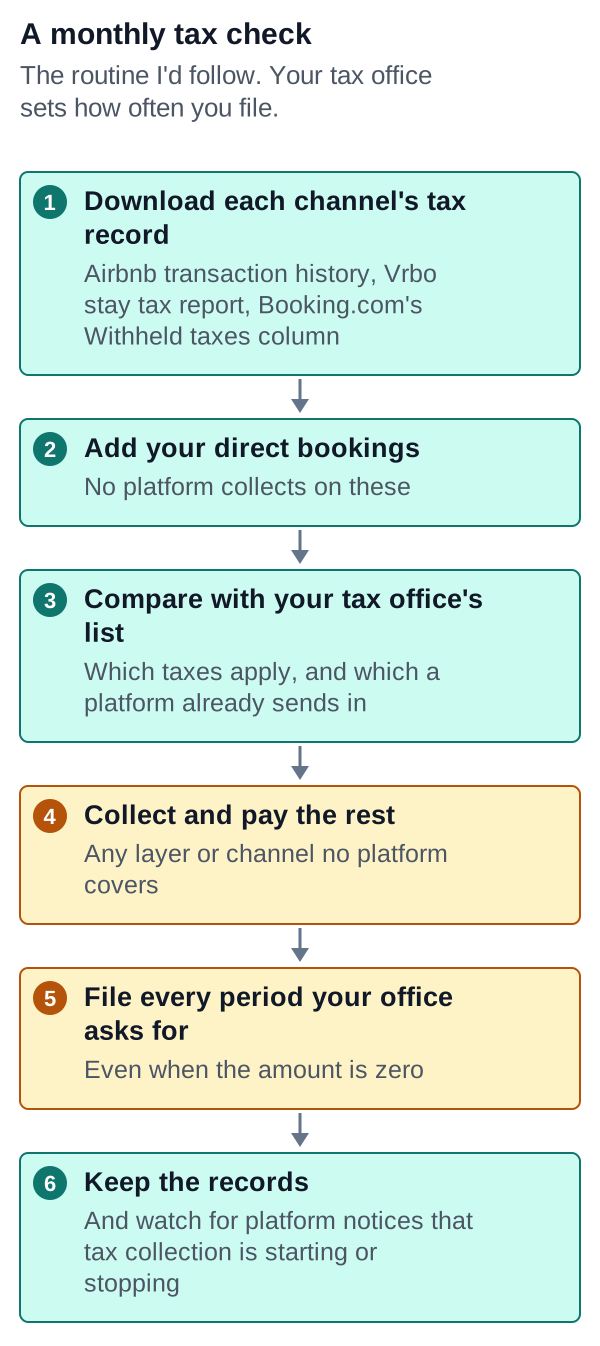
A monthly record, split by channel. Vrbo files the tax it collects under its own taxpayer account, and an answerer with the forum's Champion badge in the November 2023 Community Center thread says Airbnb forwards tax "in one lump sum" rather than per listing. Your own record, built from each platform's tax report, is what ties a payment to your listing.
Vrbo suggests showing its stay tax report when "a tax authority or auditor asks you to show which taxes Vrbo collected and remitted and which taxes you remit yourself." Its dashboard taxes page says "By continuing to accept bookings, you agree that you’re registered as a taxpayer," and that Vrbo may require "your tax registration number and documentation that you remitted all taxes" upon inquiry or audit.
On Airbnb, collected taxes are "identified to Members on their transaction records, as applicable," per its Terms. In an April 2024 Community Center thread, a host said they'd received a state sales tax bill even though their listing showed taxes collected by Airbnb. A reply pointed them to the Earnings tab's downloadable CSV, which lists the taxes collected. Booking.com shows what it withheld in a "Withheld taxes" column, per its partner help.
I'd also watch for platform emails. Vrbo's collection and remittance page says "We’ll email you to let you know when we start to collect and remit lodging tax in your area," and Airbnb's Terms say it will give notice before it stops collecting.
If you've already hosted without collecting
Back tax, penalties and interest can apply, and lookbacks can reach several years. Some tax offices run voluntary disclosure programs, and some cover lodging taxes. Coming forward first may reduce penalties. One state revenue department's voluntary disclosure program, for example, lists hotel and motel excise taxes among the taxes it covers.
If I found I'd missed it, I'd call the tax office before it called me, and I'd bring a tax professional for the numbers.
Three Airbnb occupancy tax steps before the first booking
Before a first guest arrives, I'd check each channel's tax settings or tax report for that listing and note what each platform says it collects. Then I'd send my tax office the five questions above and keep the reply. The last piece is a monthly record by channel, with direct bookings added by hand.
The rest of a new host's setup is in our guide to the first ninety days.
Common questions
Do I have to pay occupancy tax if Airbnb collects it?
Usually not for the taxes Airbnb collects and remits; those come from the guest, and Airbnb sends them in. Its Terms do let it seek a shortfall in the taxes it collected from you, including from future payouts. Airbnb may also collect only some layers, and the same Terms leave "determining and fulfilling your obligations" to the host. Other taxes, other channels and direct bookings usually stay with you, and some tax offices still want registration or returns. Your listing's Taxes settings show whether Airbnb collects there.
Who pays occupancy tax, the host or the guest?
It's usually charged to the guest, on top of your price. Airbnb's tax collection help says that whether or not it collects taxes, "it doesn’t change the total payout you receive as a host." If a tax isn't charged, though, the host can still owe it. The host's part is making sure every applicable tax gets charged and sent in. Sometimes a platform remits the tax itself; sometimes it collects the tax and passes it to you to file. Where nobody collects, the host usually does.
Is occupancy tax the same as income tax?
No. Occupancy tax is charged on the guest's stay and goes to state or local tax offices. Rental income is a separate matter for your federal income tax return, covered in IRS Topic 415 and Publication 527. The IRS rule for a dwelling unit you also use as a residence and rent for fewer than 15 days in the year covers income tax only, so don't read it as an occupancy tax exemption. Ask your tax office.
Do I need to register if Airbnb collects for my area?
It depends on the place. Some tax offices want platform-only hosts registered and filing returns, sometimes even at $0. Others exempt hosts whose every booking comes through a collecting platform, though an exemption may cover the state tax and not local ones. Airbnb's local laws and taxes page notes that in some areas you may need to register, get a permit or obtain a license before listing. Your tax office can tell you which applies.
Are long stays exempt from occupancy tax?
Often, but the cutoff varies. Many places exempt stays of 30 consecutive days or more, while others use 90 days, six months or 180 days. Airbnb's own per-place pages (see its list of areas) show cutoffs that vary by place, most often 29 or 30 nights and shorter, but also 89, 182 and others. Some places also require an unbroken stay or a written agreement. Ask your tax office whether the cutoff day itself counts.
Sources
Show sources (24)Hide sources
Read next
Regulations & Licensing
Short-term rental permit requirements: how to check yours
Cina ·
Pricing & Revenue
Minimum stay settings: when to hold firm and when to bend
Cina ·
Guest Experience
How to handle a guest noise complaint before neighbors call the city
Cina ·


